
Adding handmade crochet accents to your home brings instant warmth and texture to any room. When making items like couch blankets, throw pillows, sturdy storage baskets, or simple table mats, the stitch you pick makes a big difference. The right crochet stitches for home decor give your finished pieces clean lines, nice thickness, and practical durability for everyday use around the house.
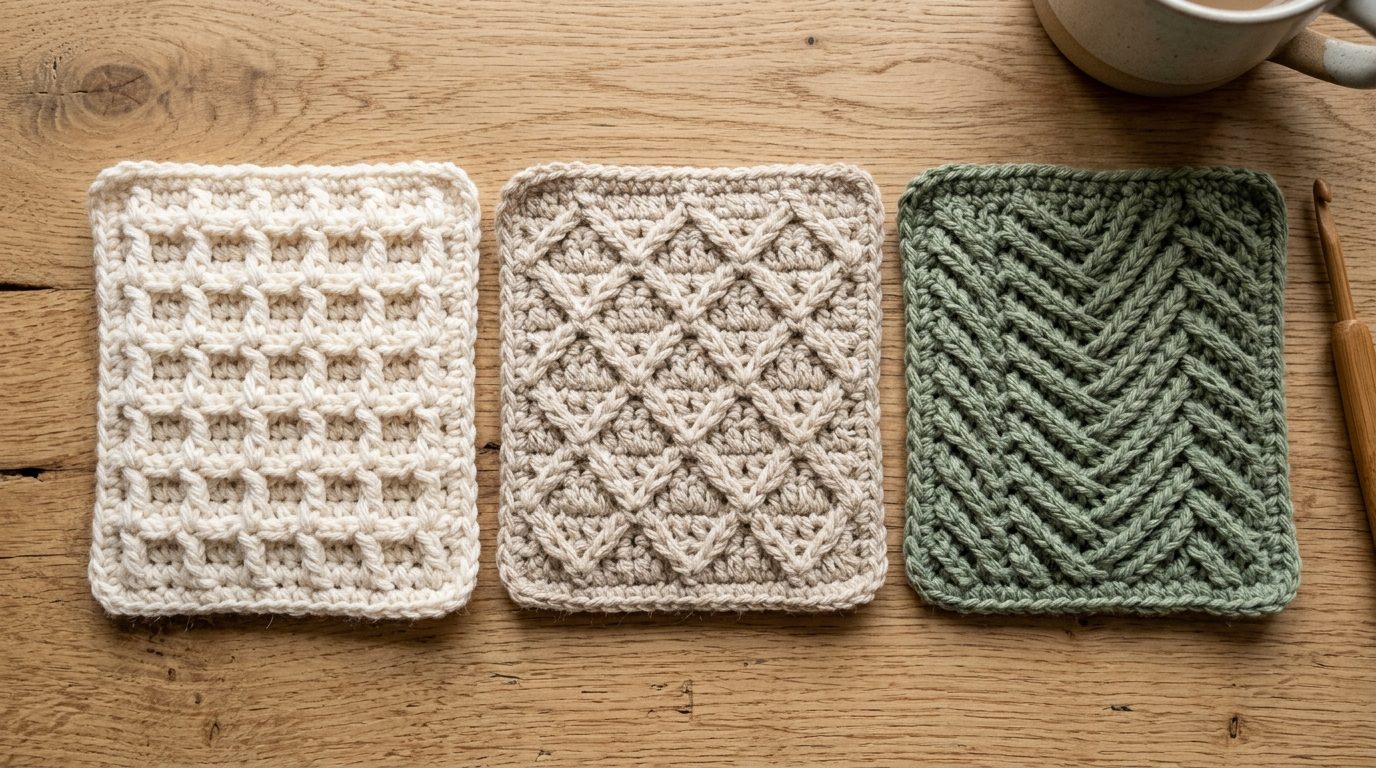
Unlike light summer tops or thin shawls, home decor projects need body and substance. A good decor stitch should lie flat, keep its shape after washing, and feel cozy to touch. Here are 8 reliable textured stitches that I use regularly in my own home projects, along with exact hook sizes, stitch multiples, and step-by-step instructions for each one.
🛠️ Maker Notes & Swatch Tests by Julian Brooks
“Pattern tested & hooked by Julian Brooks in my home workspace. To compare these stitches fairly, I made 5×5 inch test swatches using worsted weight (Medium 4) 100% unmercerized cotton yarn and an H/8 (5.0mm) ergonomic crochet hook. For dense stitches like the Thermal stitch, going up a half hook size to 5.5mm prevented the fabric from feeling too stiff. For open stitches like the Waffle, keeping even tension on your front-post stitches ensures crisp, square pockets every time.” — Julian Brooks, Home Living & Hands-On DIY Editor
MAKER ROADMAP: Ready to apply these textures to real projects? Explore our foundational Modern Crochet for the Home: Complete Beginner’s Roadmap to see how to pair each stitch with the right yarn weight and project tier.
PUT TEXTURE INTO PRACTICE: See how thermal ribbing works in everyday home items with our free textured crochet mug cozy pattern designed for ceramic coffee mugs.
Why Texture Matters for Home Projects
- Better Thickness Without Extra Lining: Stitches with raised ridges or double layers create thick, protective fabric for hot pads and coasters without needing fabric backing.
- Sturdy Sides for Storage: Stiff stitches give baskets upright stability so the walls stand on their own, just like our modern chunky storage basket.
- Heat Protection for Tables: Thick ribbed stitches trap air between hot cookware and your dining table, making them great for items like our double thick crochet potholder.
- Everyday Durability: Textured ridges hold up well to daily friction on couch cushions and floor rugs, hiding normal wear over time.
Quick Comparison: 8 Textured Stitches for Home Decor

Use this simple reference table to match the right stitch to the home item you want to make:
| Stitch Name | Texture Feel | Thickness | Best Home Use |
|---|---|---|---|
| 1. Alpine Stitch | Raised diamond ridges | Medium-thick | Throw pillows, blanket borders |
| 2. Waffle Stitch | Deep square grid | Thick & squishy | Warm couch throws, dishcloths |
| 3. Thermal Stitch | Double-thick solid rib | Very dense & stiff | Potholders, hot pads, basket bottoms |
| 4. Moss / Linen Stitch | Flat woven pebble | Medium, flexible | Placemats, table runners |
| 5. Herringbone Half Double | Slanted clean arrows | Smooth-medium | Table runners, coasters, baby blankets |
| 6. Bobble Stitch | Round 3D puffs | Thick & textured | Accent pillows, textured border stripes |
| 7. Waistcoat (Knit) Stitch | Stacked knit-look ‘V’s | Very firm & rigid | Sturdy storage bins, plant pot covers |
| 8. Lemon Peel Stitch | Fine pebbled grain | Medium, flat | Kitchen towels, dining placemats |
How to Work Each Stitch: Step-by-Step Instructions
1. The Alpine Stitch (Best for Throw Pillows)
The Alpine stitch creates a neat diamond pattern on the front side of your work. It alternates rows of single crochet on the back with double crochet and front-post treble crochet on the front.
- Stitch Multiple: Odd number of chains (multiple of 2 + 1).
- Recommended Hook: 5.0mm (US H/8) with worsted weight cotton yarn.
- Row 1: DC in 3rd ch from hook and in each ch across. Turn.
- Row 2: Ch 1, SC in each st across. Turn.
- Row 3: Ch 2 (counts as first DC), *work 1 Front Post Treble Crochet (FPtr) around the DC two rows below, skip the st behind it, DC in next st*. Repeat across. Turn.
- Row 4: Ch 1, SC in each st across. Turn.
- Row 5: Ch 2, DC in next st, *FPtr around DC two rows below, DC in next st*. Repeat across. Turn.
- Maker Tip: We used this exact stitch pattern for our modern textured crochet pillow cover because the front posts create nice, firm ridges that hold their shape on a sofa.
2. The Waffle Stitch (Best for Warm Couch Throws)
The waffle stitch forms deep, square pockets using front-post double crochet. It is soft, squishy, and traps body heat really well.
- Stitch Multiple: Multiple of 3 + 2.
- Recommended Hook: 5.5mm (US I/9) or 6.0mm (US J/10) to keep the fabric soft.
- Row 1: DC in 3rd ch from hook and each ch across. Turn.
- Row 2 (RS): Ch 2, *1 Front Post Double Crochet (FPDC) around next st, 1 DC in each of next 2 sts*. Repeat across, ending with 1 DC in last st. Turn.
- Row 3 (WS): Ch 2, *1 DC in next st, 1 FPDC around each of next 2 sts*. Repeat across, ending with 1 DC in last st. Turn.
- Repeat: Alternate Rows 2 and 3 until your blanket reaches the desired length.

3. The Thermal Single Crochet (Best for Potholders & Trivets)
Thermal stitch interlocks two rows together into one thick, solid pad. Because you catch the back loop of the current row and the open loop from the row below, there are zero gaps between stitches.
- Stitch Multiple: Any chain number.
- Recommended Hook: 5.0mm (US H/8) with 100% kitchen cotton yarn.
- Foundation: Work 1 row of regular single crochet. Turn.
- Row 2: Ch 1, insert hook through the back loop only of the first stitch AND into the unworked loop from the starting chain directly below it. Yarn over, pull through both loops (2 loops on hook), yarn over, pull through both loops. Repeat across. Turn.
- Subsequent Rows: Insert hook through the back loop of the current stitch AND the parallel open loop from the previous row. SC as normal across.
- Maker Tip: For step-by-step photos and border finishing, see our full double thick crochet potholder tutorial.
4. The Moss / Linen Stitch (Best for Placemats & Runners)
The moss stitch alternates single crochets with chain-1 spaces. Because each stitch is worked into an open space rather than through tight loops, the fabric lies completely flat with straight edges.
- Stitch Multiple: Even number of chains.
- Recommended Hook: 4.5mm (US 7) or 5.0mm (US H/8).
- Row 1: SC in 4th ch from hook, *ch 1, skip 1 ch, SC in next ch*. Repeat across. Turn.
- Row 2: Ch 2 (counts as SC + ch 1), skip first SC, *SC in next ch-1 space, ch 1, skip next SC*. Repeat across, ending with 1 SC in the turning chain space. Turn.
- Repeat: Repeat Row 2 for all rows.
- Maker Tip: If your crochet edges ever start rolling or curling, check our guide on why crochet curls and 7 simple fixes. Moss stitch is one of the easiest stitches to keep flat.
5. Herringbone Half Double Crochet (Best for Clean Modern Accents)
By pulling your first loop through the stitch and the first loop on your hook in one smooth motion, the stitch leans sideways. Turning your work on each row creates clean, angled chevron lines.
- Stitch Multiple: Any chain number.
- Step 1: Yarn over, insert hook into next stitch.
- Step 2: Yarn over and pull a loop through the stitch AND directly through the first loop on your hook (2 loops left on hook).
- Step 3: Yarn over, pull through both remaining loops.
- Maker Tip: This stitch looks sharp on modern tabletop items like our easy crochet coasters and boho table runner.
6. The Bobble Stitch (Best for Accent Borders)
Bobbles are made by working 5 unfinished double crochets into the same stitch, then closing them all together with one yarn-over. The round puff pops out clearly on the right side.
- Stitch Multiple: Multiple of 4 + 1 (with 3 single crochets between each bobble).
- How to make a bobble: *Yarn over, insert hook in stitch, pull up a loop, yarn over, pull through 2 loops* repeat 5 times in the same stitch (6 loops on hook). Yarn over, pull through all 6 loops.
- Lock the stitch: Work 1 single crochet in the very next stitch to push the bobble forward.
7. The Waistcoat / Knit Stitch (Best for Sturdy Storage Baskets)
The waistcoat stitch looks just like knitted stockinette stitch. Instead of working under the top two loops of a single crochet, you insert your hook right through the center ‘V’ of the post on the front.
- Best worked in the round: Continuous spiral rounds prevent visible seams.
- How to insert hook: Look at the front of the single crochet post. Push your hook straight through the center of the ‘V’, underneath the horizontal bar. Yarn over, pull up a loop, yarn over, pull through both loops.
- Maker Tip: Keep your tension loose. Because you are working into the post itself, tight tension will make it hard to insert the hook on the next round.
8. The Lemon Peel Stitch (Best for Kitchen Towels & Mats)
This simple stitch alternates single crochet and double crochet across each row. The height difference creates a gently bumpy surface that looks like citrus peel.
- Stitch Multiple: Odd number of chains.
- Row 1: SC in 2nd ch from hook, DC in next ch, *SC in next, DC in next*. Repeat across. Turn.
- Row 2: Ch 1, *SC in top of first DC, DC in top of next SC*. Repeat across. Turn.
- Maker Tip: Lemon peel stitch lies very flat and dries fast, making it my favorite choice for our modern farmhouse placemats.
How to Style Textured Pieces in Your Home

When placing handmade crochet pieces around your home, simple styling tricks make them fit naturally into your space:
- Mix Different Textures: If you have a chunky waffle stitch throw on your couch, use a smoother moss stitch or linen pillow beside it. Mixing textures keeps things visually interesting without looking busy.
- Use Neutral, Earthy Yarn Colors: Stitches with lots of texture look best in solid, neutral tones like cream, oatmeal, warm taupe, or soft sage green. Variegated yarns can hide the neat stitch patterns.
- Pair with Wood and Stone: Soft cotton and wool textures look great sitting on raw wood coffee tables, concrete surfaces, or quartz counters. To pick the best yarn for home projects, check out our guide to the best cotton yarns for crochet coasters and home decor.
3 Practical Tips for Clean Stitches
1. Go Up Half a Hook Size for Front-Post Stitches: Front-post stitches (like Alpine and Waffle) pull yarn tightly in the vertical direction. Using a hook 0.5mm larger than usual keeps your fabric soft and prevents curling.
2. Keep Your Yarn Tension Relaxed: When pulling loops through on herringbone or thermal stitches, avoid pulling too tight. Relaxed tension makes working into loops on the next row much easier.
3. Steam-Block Your Finished Pieces: Pinning your completed coasters, placemats, or pillow panels flat onto foam mats and applying gentle steam evens out your stitches and gives you crisp, square edges.
Frequently Asked Questions
Which textured crochet stitch uses the most yarn?
The Waffle Stitch and Bobble Stitch use about 25% to 35% more yarn than basic single crochet because of the extra loops and post stitches. Make sure to buy an extra skein when planning a blanket or pillow in these stitches.
What is the easiest textured stitch for a beginner?
The Moss Stitch (Linen Stitch) and Lemon Peel Stitch are both very easy for beginners. They use standard single and double crochets without any front-post work, but still produce a clean, textured surface.
Can I use acrylic yarn for home decor items?
Acrylic works well for sofa blankets and decorative cushions because it is soft and machine-washable. For kitchen items like potholders, trivets, and placemats, always use 100% cotton yarn because acrylic will melt under hot pots and warm dishes.
Why is my waffle stitch curling at the edges?
Waffle stitch curls because front-post stitches pull the fabric vertically. To fix it, use a 0.5mm larger hook, add a 2-row single crochet border around the edge, and steam-block the finished project.
Save This Stitch Guide on Pinterest
Planning your next weekend crochet project? Save this textured stitch guide to your Pinterest crochet board so you can easily reference the step-by-step instructions whenever you are ready to hook!
Leave a Comment