Stacking nonstick skillets, enameled Dutch ovens, and ceramic pie dishes inside kitchen drawers is an easy way to end up with chipped coatings and scratched cooking surfaces. This tested crochet cookware protector pattern solves that storage problem cleanly: worked with a hexagonal center disc and six radiating flexible arms, it forms a star-shaped cushion that wraps around cookware bases and sidewalls to keep nested pans pristine.
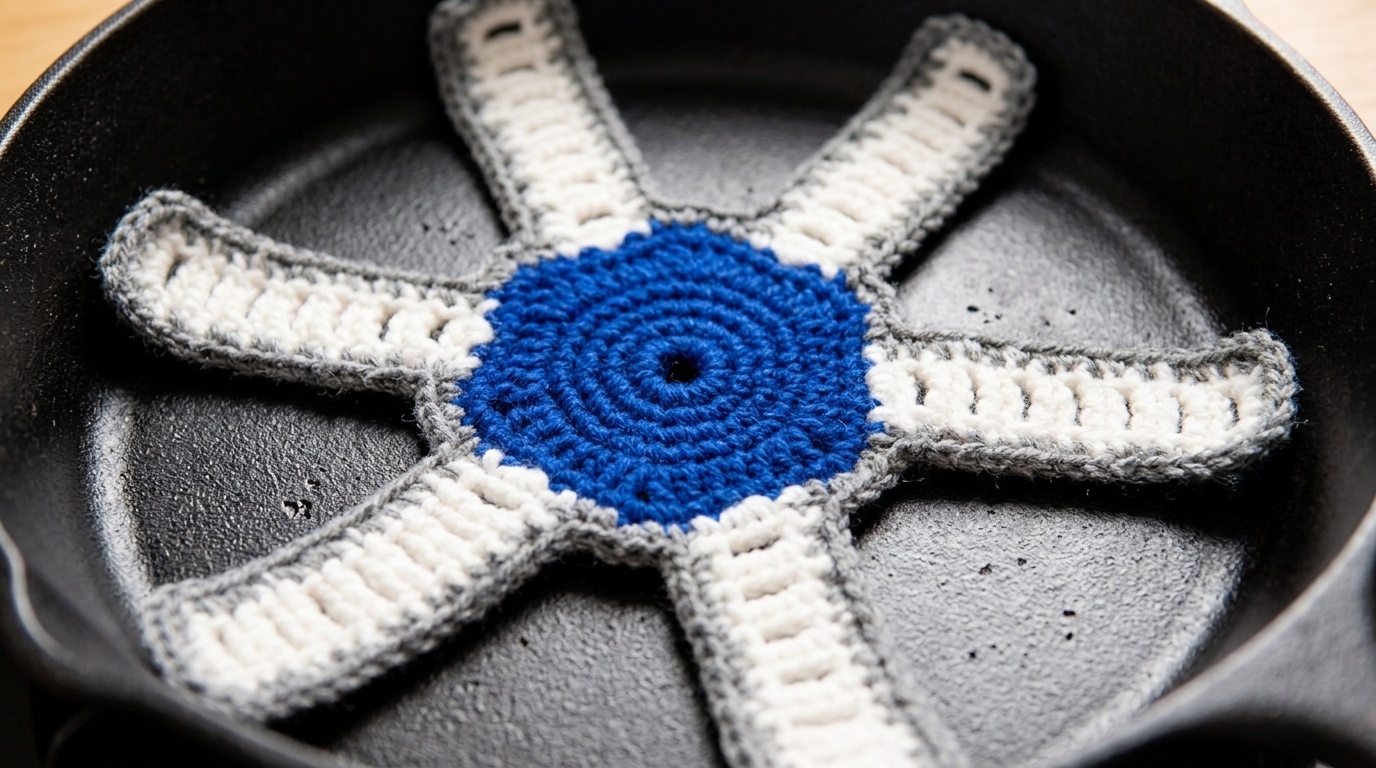
While felt store-bought pan liners tend to fray, pill, and tear after a few months of drawer shuffling, a densely crocheted worsted yarn protector provides thick, washable shock absorption that lasts for years. Measuring approximately 14 inches across the tips, this design spans standard 10-inch and 12-inch frying pans effortlessly. The open mesh stitch pattern on each arm offers flexible ventilation, allowing airflow so trapped moisture cannot promote rust on cast iron between uses.
Project Blueprint: Fiber Selection, Hook Calibration & Cushion Gauge
Because cookware protectors live inside storage cupboards rather than on active stovetops, selecting the right durable yarn ensures resilience against daily friction without shedding lint onto cooking surfaces.

- Yarn Requirements: Category 4 Worsted Weight Yarn (such as Red Heart Super Saver). For a classic two-tone protector: Contrast A (Royal Blue or Forest Green, approx 20 yds for center), Contrast B (Crisp White or Oat, approx 15 yds for arms), and Contrast H (Heather Gray, approx 18 yds for stabilizing border). Total yarn needed is under 55 yards per protector.
- Hook Size: U.S. H/8 (5.0 mm) aluminum or ergonomic crochet hook. This creates firm, resilient single crochets that resist flattening under heavy Dutch ovens.
- Notions Needed: Large-eye yarn needle for weaving tails, sharp embroidery snips, tape measure.
- Finished Dimensions: Approximately 14 inches (35.5 cm) from arm tip to opposing arm tip, with a 5-inch (12.5 cm) central hexagonal base disc.
- Gauge Standard: 14 single crochet stitches and 15 rows = 4 inches (10 cm). Consistent gauge ensures the protector base fits snugly in skillet flat wells without ruffling.
Hexagonal Disc Geometry & Expanding Corner Mathematics
The core foundation of the cookware protector is a flat hexagonal disc built across six rounds. Rather than a standard circle, creating six defined flat edges allows the arms to emerge at exact 60-degree angles, creating balanced radial protection around circular pots.

Here is how the hexagonal geometry unfolds from center ring to outer edge:
- Center Foundation Ring: Ch 6, join with sl st to form a ring. Round 1 works 12 sc into the ring to anchor the center without puckering.
- Expansion Rounds: Rounds 2 through 4 systematically increase by 6 to 9 stitches per round (Round 2: 18 sc, Round 3: 27 sc, Round 4: 36 sc) ensuring the center pad remains completely flat on kitchen countertops.
- Hexagon Corner Creation (Round 5): Here we transition the circle into six distinct flat edges using a combination of double crochets and half double crochets: *(1 dc, ch 1, 1 dc) into next sc for corner point, 1 dc, 3 hdc, 1 dc. Repeat 6 times around (7 sts per side between corner chain-1 spaces).
- Outer Frame Setup (Round 6): Work *(1 sc, ch 1, 1 sc) into corner ch-1 space, then 1 sc in each of the 7 stitches along the edge. Join with sl st. You now have 6 clean edges with 9 stitches each, ready for arm attachment.
Step-by-Step Radial Arm Construction & Stabilizing Border
Each of the six arms is worked directly off the middle section using short rows back and forth. You never need to cut yarn between individual rows of an arm.
Arm Foundation Row: With RS facing, join your arm color with a sl st to the 3rd sc from any corner ch-1 space of Round 6. Work 1 sc in same space, skip next sc, work 3 sc in next sc, skip next sc, work 1 sc in next sc. Turn, leaving remaining edge stitches unworked. (5 sc)
Row 2 (Mesh Window Row): Ch 1, 1 sc in first sc, ch 3, skip next 3 sc, 1 sc in last sc. Turn.
Row 3 (Solid Infill Row): Ch 1, 1 sc in first sc, work 3 sc directly into the ch-3 loop space, 1 sc in last sc. Turn. (5 sc)
Rows 4 to 15 (Arm Elevation): Alternate Rows 2 and 3 until you complete 15 total rows. Fasten off. Repeat this exact 15-row sequence across each of the remaining five sides of the hexagon.
Continuous Perimeter Border: With RS facing, join Contrast H with a sl st in any corner ch-1 space of Round 6. Ch 1, work 2 sc in corner, 1 sc in next st, then work an Sc2tog across the base corner and the side of Row 1 of the arm. Work 13 sc spaced evenly up the arm edge, 3 sc in top corner, 3 sc across Row 15, 3 sc in opposite top corner, 13 sc down the other side, and an Sc2tog anchoring back to Round 6. Repeat around all 6 arms. Join with sl st, fasten off, and weave in ends.
Custom Sizing Matrix: Scaling from Skillet Nesting to Stockpots
Cookware collections range from compact 8-inch omelet pans to deep 6-quart Dutch ovens. Use this quick modification matrix to customize your protectors:
| Cookware Size | Hexagon Disc Size | Arm Length (Rows) | Total Wingspan | Recommended Cookware |
|---|---|---|---|---|
| Small (8-Inch) | Round 5 (approx 4 in) | 11 rows | Approx 11 in (28 cm) | Omelet pans, saucepans, crepe pans |
| Standard (10-12 Inch) | Round 6 (approx 5 in) | 15 rows (Tested) | Approx 14 in (35.5 cm) | Cast iron skillets, chef pans, sauteuses |
| Large (14-Inch+ / Dutch Oven) | Round 6 + 1 extra rnd | 19 rows | Approx 17 in (43 cm) | Enamel Dutch ovens, roasting dishes, woks |
For more tested textile projects designed to protect your dining and cooking surfaces, take a look at our step-by-step guides on crocheting sturdy cord-core coasters and organizing kitchen spaces with a crocheted hanging storage basket.
Pantry Organization & Cabinet Storage Styling
Cookware protectors do more than prevent physical scratching; they eliminate the unpleasant clanking and metal grinding that happens whenever you pull a pan from a deep kitchen drawer.

Here are three practical ways to integrate these protectors into your kitchen routine:
- Enameled Cast Iron Dutch Oven Protection: Place a large protector inside your enameled Dutch oven before inverting the heavy cast iron lid upside down for compact shelf storage.
- Nonstick Skillet Nesting: Layer protectors between 8, 10, and 12-inch frying pans to completely shield sensitive PTFE and ceramic coatings from abrasive metal bottoms.
- Ceramic & Stoneware Bakeware Stacking: Cushion glass pie plates and ceramic lasagna bakers to eliminate micro-chips along fragile glazed rim edges.
Care, Machine Laundering & Shape Retention
Because these protectors live in kitchen cabinets, they will occasionally pick up traces of cooking oil or dust. Keeping them fresh requires minimal effort:
- Machine Washing: Toss them in with your regular laundry cycle using warm water and standard detergent. Synthetic worsted acrylic or sturdy cotton blends will not shrink or lose their shape.
- Tumble Drying: Tumble dry on medium heat or lay flat on a counter to dry. The perimeter single-crochet border locks the arm structure, preventing curling after machine agitation.
- Safety Notice: These protectors are designed strictly for storage cushioning. Do not use them as hot pads or trivets under boiling cookware straight from the stovetop or oven.
Common Maker Questions & Troubleshooting Q&A
Why are the edges of my arms curling outward during Row 3?
Curling on the arms happens if you work more than 3 single crochets into the chain-3 space. Make sure to work exactly 3 sc around the chain arch rather than into the chain stitches themselves.
Can I use leftover scrap yarn for the arms?
Absolutely! This pattern is an ideal scrap-buster. You can make each of the six arms in a completely different stash color, tying the whole piece together with a single uniform border shade on Round 1.
What if my center disc is ruffling and not lying flat?
If your hexagon ruffles in Rounds 3 or 4, your tension may be on the tighter side, causing the increase rates to bunch. Blocking the center lightly with steam will instantly smooth it flat, or you can drop down to a 4.5 mm hook for the center disc.
Will acrylic yarn scratch delicate nonstick coatings?
No. Standard smooth acrylic yarn fibers are significantly softer than Teflon, ceramic coatings, or seasoned cast iron. They provide a gentle, non-abrasive barrier that prevents metal-to-metal contact.
Save This Cookware Protector Pattern to Pinterest
Ready to organize your kitchen cabinets and safeguard your cookware investment? Pin this tested crochet pan protector tutorial to your Crochet Projects or Kitchen Organization board so you can easily reference the row instructions!
Leave a Comment