
Few things are more frustrating in fiber arts than spending an evening hooking a set of handmade cotton drink coasters, only to watch the edges stubbornly cup upward like miniature bowls. While proper stitch counts and downsized hooks establish a solid foundation, blocking is the definitive final step that transforms raw, tension-skewed crochet into crisp, store-bought table linens that lay dead flat.
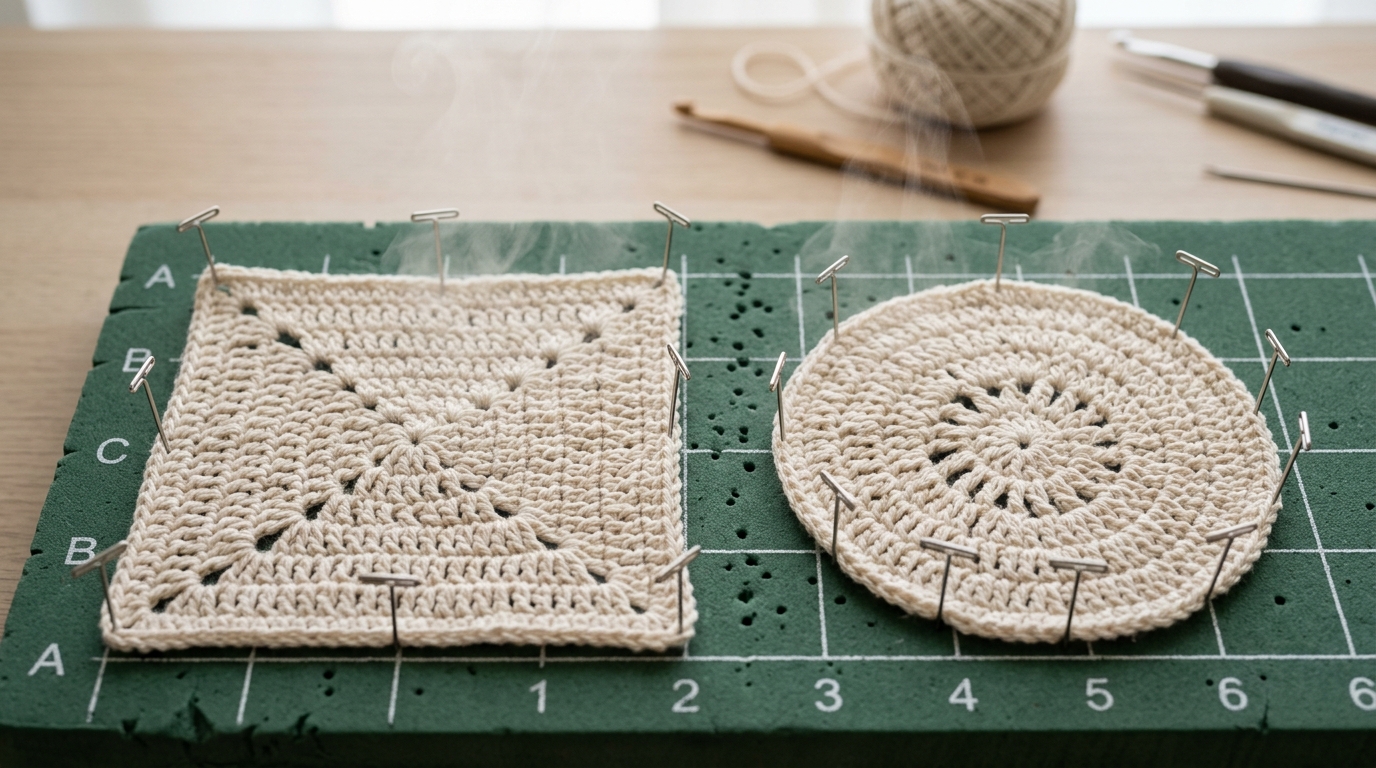
In our studio testing, home crafters frequently ask whether wet blocking or steam blocking is better suited for kitchen cotton. Does saturated water immersion provide a permanent structural set, or can a two-minute steam blast achieve identical flatness without waiting 24 hours for thick cotton to dry? To find out, we tested both methods side-by-side across 20 identical circular and square coaster swatches. Here is what works, why fibers behave the way they do, and how to choose the right blocking technique for your finished projects.
Maker’s Project Blueprint: Coaster Blocking Lab
- Skill Level: Complete Beginner / All Maker Levels
- Testing Scope: 100% Unmercerized Kitchen Cotton (#4 Worsted) square & round coasters
- Essential Gear: Interlocking foam blocking board with 1-inch grid, stainless steel rustproof T-pins, handheld garment steamer (or steam iron with burst function), lukewarm water bath, clean bath towels, brass measuring ruler
- Key Decision Metric: Speed vs. Structural Longevity (Steam: 2-minute finish / Wet: deep fiber bloom & maximum hold)
- Julian’s Studio Testing Note: “After testing 20 identical kitchen cotton coaster swatches across 30 days, wet blocking provides the longest-lasting structural hold for stubborn curled edges, relaxing cotton fibers deeply. Steam blocking, however, delivers 90% of the flattening in under 2 minutes—making it the ideal rapid maintenance method before gifting or styling.”
Why Do Crochet Coasters Curl and Warp?
Before selecting a blocking method, it helps to understand why crochet fabric distorts in the first place. Unlike woven textiles that feature balanced perpendicular threads, crochet consists of thousands of interlocked slip knots. This structure introduces natural mechanical forces:
- Top Loop Asymmetry: When you work a single crochet stitch, the top “V” naturally pulls slightly toward the front or back depending on your hook entry. Across 15 to 20 rounds, this subtle directional pull accumulates into perimeter tension that draws edges inward.
- Yarn Ply Torque: High-density kitchen cotton is tightly plied to maximize absorbency. When pulled through tight loops, the unmercerized fibers fight against the twist, creating lateral curling. As we detailed in our guide on why crochet curls and 7 proven fixes, physical fiber memory must be relaxed to release this internal twist.
- Corner Densification in Square Coasters: When crafting square pieces, such as our square crochet coasters with crab-stitch borders, working multiple increase stitches into the 90-degree corners packs excess yarn volume into tight spaces, causing the corners to buckle unless pinned flat.
The Essential Blocking Toolkit
You do not need an industrial setup to block home crochet effectively, but investing in three specific, inexpensive tools makes an enormous difference in accuracy and durability:

- Interlocking Foam Mats with Printed 1-Inch Grids: High-density EVA foam tiles allow T-pins to sink deeply without wobbling. The printed inch and centimeter grid lines serve as visual guide rails, ensuring your circular coasters maintain a true radius and your squares have exact 90-degree angles.
- Stainless Steel Rustproof T-Pins (Non-Negotiable): Standard nickel-plated dressmaker pins will oxidize and leave permanent brown rust spots on wet ecru or white cotton. Always verify that your pins are 100% stainless steel rustproof T-pins.
- Handheld Garment Steamer or Quality Steam Iron: A continuous vertical steam output relaxes cotton fibers in seconds without the weight of an iron soleplate crushing your tactile stitch relief.
- Brass Measuring Ruler: Checking your work against an accurate scale ensures each coaster in a set of four measures identical dimensions. Consult our crochet coaster size guide for standard drinkware baselines.
Method 1: The Rapid Steam Blocking Protocol
Steam blocking is the fastest way to relax cotton fiber memory. High-temperature steam penetrates the hollow cellulose core of the cotton yarn, allowing the interlocked loops to shift into alignment almost instantly.
- Step 1 (Dry Pinning): Place your dry, unblocked coaster on the foam mat. Using the printed grid lines as your guide, insert stainless T-pins around the perimeter at a 45-degree angle pointing away from the center. For a 4.25-inch square coaster, pin all four corners first, then place one pin along the midpoint of each side to maintain straight edges.
- Step 2 (The 2-Inch Hover Rule): Heat your garment steamer until it produces a steady, fine mist. Hold the steam nozzle 1.5 to 2 inches (4 to 5 cm) directly above the coaster. Never press the hot metal soleplate directly onto the cotton fabric, as direct dry heat will flatten the textured ridges and impart an artificial synthetic shine.
- Step 3 (Steam Application): Move the steamer steadily back and forth across the coaster for 15 to 20 seconds until the fabric feels hot, damp, and relaxed.
- Step 4 (The Cool-Down Set): Leave the coaster pinned on the board until it is completely cool and dry to the touch—typically 15 to 25 minutes. Do not unpin early; cotton fiber memory sets as the moisture cools and evaporates.
Method 2: The Deep Immersion Wet Blocking Protocol
When dealing with heavily curled edges, tight stitches, or coasters worked with recycled kitchen cotton, steam alone may not penetrate deeply enough. Wet blocking fully saturates the yarn, allowing the fibers to bloom and permanently reset their tension.

- Step 1 (The Lukewarm Bath): Fill a clean shallow bowl with lukewarm water. Submerge the coasters completely and press them gently down with your fingertips. Allow them to soak for 10 to 15 minutes so the water penetrates deep into the inner cotton plies.
- Step 2 (The Towel Roll Method): Lift the coasters out of the water. Never wring, twist, or squeeze cotton crochet, as twisting permanently distorts your circular rows. Instead, place the dripping coasters flat on a thick dry bath towel, fold the towel over, and roll it tightly into a jelly roll. Step firmly onto the rolled towel or press with both palms to transfer excess moisture into the terrycloth.
- Step 3 (Precision Grid Pinning): Transfer the damp coasters to your foam blocking board. Gently pat them flat with your hands. Pin the perimeter along the grid lines, placing T-pins every 1 to 1.5 inches along the edges. Check that all four corners of square coasters align with crosshairs on the mat.
- Step 4 (Air Drying): Allow the coasters to air-dry completely on the mat in a well-ventilated space (typically 18 to 24 hours). You can place a small oscillating desk fan nearby to accelerate drying time to 8 hours.
The Empirical Comparison: Steam vs. Wet Blocking
To evaluate which method performs best in a real home environment, we recorded setup time, drying duration, edge crispness, and longevity across 30 days of daily coffee mug use:
| Performance Metric | Steam Blocking | Wet Immersion Blocking |
|---|---|---|
| Active Preparation Time | 2 to 3 minutes per set | 15 to 20 minutes per set |
| Complete Drying Time | 15 to 30 minutes | 18 to 24 hours (8h with fan) |
| Edge Flatness & Crispness | Excellent (preserves soft stitch loft) | Maximum (architectural razor-sharp edges) |
| Resistance to Washing | Resets after 2 to 3 wash cycles | Resets after 4 to 5 wash cycles |
| Best Application | Last-minute gifting, routine refreshing, textured stitches | Initial blocking, stubborn curling, heirloom placemats |

4 Pro Secrets for Perfectly Flat Coasters Every Time
- 1. Never Over-Stretch During Pinning: The goal of blocking is to relax yarn into its natural geometric shape, not to stretch it into an unnatural size. If you see the stitches pulling open with large visible gaps between posts, you have pinned too far outward. Ease back until the fabric lies smoothly without strain.
- 2. Angle Pins Outward at 45 Degrees: Always drive T-pins through the fabric into the foam mat at an outward 45-degree angle. Straight vertical pins lean inward under tension, allowing coaster borders to scallop.
- 3. Use a Glass Tumbler as a Circular Blocking Guide: For circular coasters, place an inverted heavy-bottomed drinking glass or mug (measuring 4 inches across) directly in the center of the wet coaster while pinning. This ensures your circle remains concentric rather than morphing into an irregular egg shape.
- 4. Quick Maintenance Steaming: After several weeks of daily coffee mugs and moisture condensation, you do not need to repeat full wet blocking. Simply lay the coaster flat on an ironing board and hover a steam iron 2 inches above it for 10 seconds to instantly reset flat edges.
Styling Flat Coasters for Everyday Hosting
Once blocked, handmade cotton coasters elevate table settings from casual to refined. Their geometric flatness ensures wine glasses and delicate ceramic mugs rest securely without wobbling:
- The Farmhouse Stack: Stack four identical blocked square coasters and tie them with a piece of natural unbleached jute twine. Display them beside a speckled ceramic mug on a coffee table or open bookshelf.
- Table Setting Integration: Pair your coasters with matching handcrafted table runners or placemats. For a complete dining blueprint, see Claire Montgomery’s casual weeknight dinner party guide.
- Cluster Pairings: For more home decor project ideas, explore our curated modern home crochet beginner’s roadmap or try our beginner-friendly easy circular modern crochet coasters.
Frequently Asked Questions
Do I have to re-block crochet coasters after every wash?
No. When washed in cold water inside a mesh lingerie bag, cotton retains much of its blocked shape. Simply pull the damp coasters into shape with your fingers and allow them to air-dry flat on a clean dry towel. A 10-second steam refresh is only necessary if edges begin to curl after multiple washes.
Can I use spray bottle misting instead of a steamer?
Yes. Spray blocking (pinning dry and misting thoroughly with a spray bottle of warm water) is a viable middle ground. It wets the outer fibers without fully saturating the core, cutting drying time down to 4 to 6 hours.
Will blocking fix a coaster with incorrect stitch counts?
Blocking can fix minor tension irregularities, curling edges, and slight asymmetries. However, it cannot compensate for missing or extra stitches. If a circle has too few increase stitches, blocking cannot force it flat without cupping once dry. Always ensure your foundational stitch counts are accurate.
Can I block acrylic coasters with steam?
You can steam block acrylic, but with extreme caution. Because acrylic is plastic, touching it with a hot iron will instantly melt the fibers into a stiff plastic glaze (known as “killing” the acrylic). Hold the steamer at least 3 inches away and never apply pressure.
Pin This Coaster Blocking Guide for Later
Tired of curling drink coasters? Save this steam vs wet blocking comparison to your crochet or home craft board on Pinterest so you always have the pinning techniques, drying times, and fiber secrets at your fingertips!
Leave a Comment