
There is a quiet luxury in walking into a room that carries a faint, grounding botanical scent. Unlike commercial aerosol sprays or synthetic plug-in air fresheners that overwhelm living spaces with harsh synthetic musks and phthalates, learning how to make a reed diffuser with pure essential oils allows you to perfume your home gently, naturally, and continuously for months on end.
Reed diffusers are among the most effortless forms of home scenting. They require no open flame like beeswax candles, no electricity or noisy pumps like ultrasonic mists, and zero daily maintenance once blended. By combining lightweight carrier oil with therapeutic-grade essential oils and natural rattan reeds, you can create bespoke, seasonal home fragrance formulas that support calm, focus, and restorative rest in every room.
How Capillary Wicking Works: Why Rattan Reeds Outperform Bamboo
The secret to a successful homemade diffuser lies entirely in the reeds you choose. Many DIY tutorials recommend using standard kitchen bamboo skewers, but bamboo rarely produces noticeable scent throw:
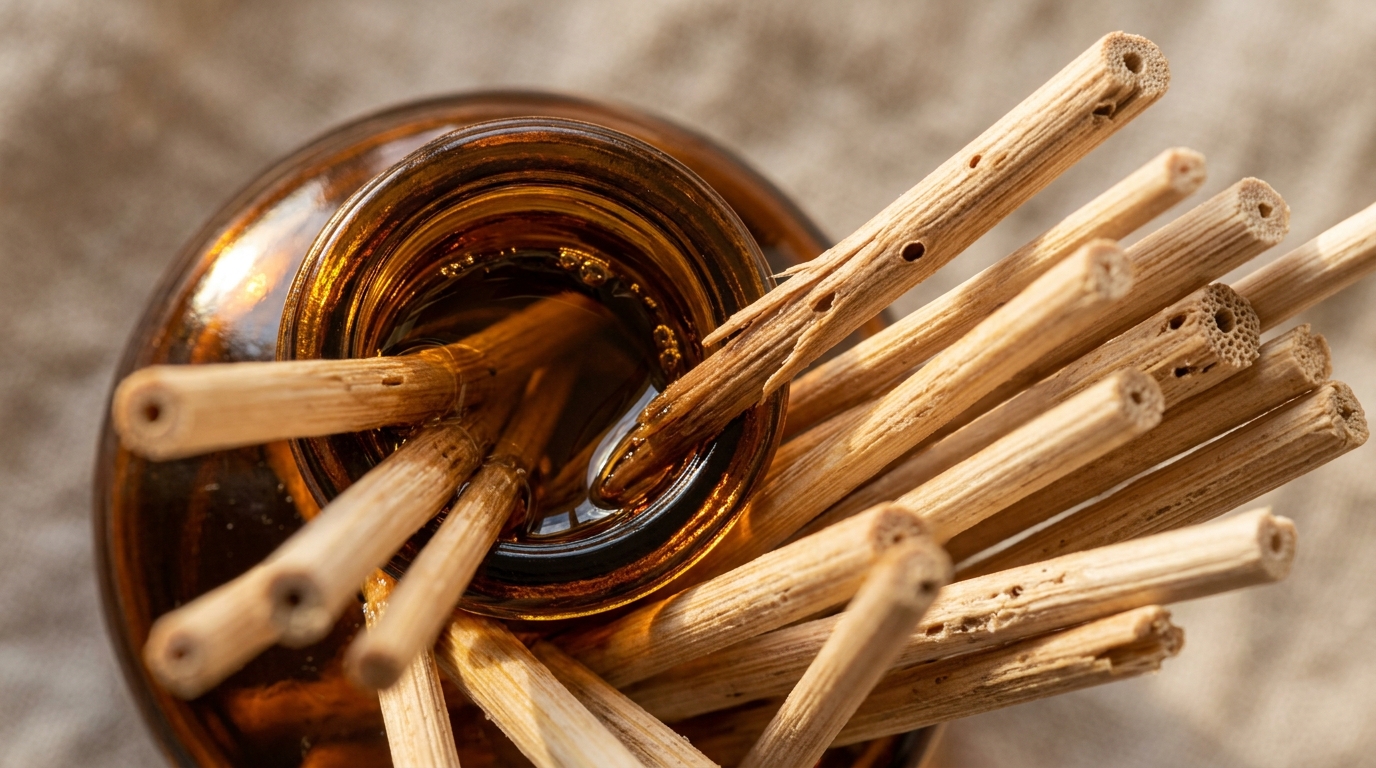
- Porous Rattan Vascular Channels: High-grade diffuser sticks are crafted from natural rattan reed, a vine-like plant filled with dozens of hollow microscopic tubular channels running parallel down its entire length. These channels act as natural straws, pulling oil upward via capillary action toward the dry tip where it slowly evaporates into room air.
- The Bamboo Skewer Mistake: Bamboo is a dense, fibrous grass with solid nodal segments. Bamboo fibers swell when submerged in oil, closing off surface pores and trapping fragrance at the bottom of the bottle. Always source genuine unbleached rattan diffuser reeds (approx. 2.5 mm to 3 mm in diameter) for steady, reliable wicking.
- Reed Length & Diameter: Reeds should extend roughly twice the height of your container. For a standard 4-ounce apothecary bottle (approx. 4.5 inches tall), select reeds measuring 9 to 10 inches long.
Choosing Your Carrier Oil: Sweet Almond vs Fractionated Coconut vs Safflower
Essential oils are too concentrated and volatile to use alone; without a stabilizing carrier liquid, they evaporate in days or fail to travel up the reeds. The viscosity of your carrier oil directly controls scent performance:

- Fractionated Coconut Oil (MCT): The gold standard carrier for DIY diffusers. Because the long-chain fatty acids have been removed, it remains completely liquid at room temperature, has near-zero viscosity, does not turn rancid over time, and is completely odorless.
- Sweet Almond Oil or Safflower Oil: Excellent light-weight vegetable oils that are readily available in most pantry cabinets. Their slightly golden tint pairs beautifully with vintage amber glass bottles, and their low viscosity allows effortless wicking.
- Avoid Heavy Pantry Oils: Never use heavy oils like standard extra virgin olive oil, canola oil, or castor oil. Their dense molecular structure instantly clogs porous reed capillaries and prevents oil from climbing beyond the waterline.
- The Alcohol Evaporation Accelerator: Adding 1 teaspoon of high-proof alcohol (90%+ isopropyl alcohol or pure grain alcohol) thins the carrier oil slightly and speeds up initial capillary ascent, helping the scent throw establish within the first 12 hours.
Essential Oil Ratios & Autumn Botanical Scent Formulations
A balanced reed diffuser blend requires roughly 30 to 35 drops of pure essential oil per 1/4 cup (60 ml) of carrier oil (approximately a 15% to 20% fragrance concentration). Crafting long-lasting blends requires layering top, middle, and grounding base notes:
- Blend 1: Cozy Autumn Woods (Grounding & Warm):
- 16 drops Atlas Cedarwood (grounding woody base)
- 12 drops Sweet Orange (uplifting citrus top note)
- 5 drops Clove Bud (cozy autumn spice middle note)
- 2 drops Frankincense (resin anchor)
- Blend 2: Tranquil Evening Lavender (Bedroom Wind-Down):
- 18 drops French Lavender (herbal floral middle note)
- 10 drops Bergamot (gentle citrus top note)
- 6 drops Sandalwood or Amyris (rich creamy wood base)
- Blend 3: Mountain Forest Pine (Crisp & Purifying):
- 16 drops Black Spruce or Siberian Fir (conifer middle note)
- 10 drops Rosemary (herbaceous clarifying top note)
- 6 drops Atlas Cedarwood (deep evergreen anchor)
Step-by-Step Bottle Preparation & Blending Method
Follow this simple apothecary method to mix and activate your reed diffuser in under 10 minutes:

- Sanitize the Vessel: Wash your small glass bottle with hot soapy water and ensure the interior is completely dry. Any residual water droplet will cause carrier oil to cloud and hinder capillary wicking.
- Pour the Carrier Liquid: Place a small stainless steel funnel into the bottle mouth. Pour in 1/4 cup (60 ml) of fractionated coconut oil or sweet almond oil, followed by 1 teaspoon of high-proof alcohol.
- Incorporate Essential Oils: Drop in 30 to 35 drops of your chosen essential oil blend. Remove the funnel and swirl the bottle gently in circular motions for 30 seconds to dissolve the aromatic oils into the carrier.
- Insert & Prime the Reeds: Submerge 5 to 7 natural rattan reeds into the liquid, letting them stand for 1 hour to absorb the oil from the base. Then, carefully remove the reeds, flip them upside down, and submerge the dry ends back into the bottle. Priming both tips jumpstarts immediate scent diffusion!
Strategic Room Placement for Maximum Passive Scent Throw
Unlike active electric mist diffusers that project moisture across large spaces, reed diffusers rely entirely on ambient airflow to distribute fragrance:

- Place in Areas of Natural Movement: The best spots are high-traffic transition zones—entryway console tables, hallway shelves, or bathroom vanities. Walking past creates a subtle draft that naturally carries the scent molecules into the surrounding space.
- Keep Away from Heat & Sun: Avoid placing diffusers on sunny windowsills or directly above radiators and heat vents. Direct heat accelerates carrier oil evaporation rapidly without increasing scent throw, drying out your bottle in half the time.
- Protect Furniture Surfaces: Always set your glass bottle on a glazed ceramic tray, marble coaster, or brass plate. Essential oils can strip wood finishes or leave permanent watermarks on unsealed vintage surfaces if droplets drip down the sides during reed flipping.
Troubleshooting Reed Saturation, Scent Fading & Evaporation Rates
Maintain consistent fragrance throw throughout the autumn season with these mindful upkeep practices:
- Flip Reeds Weekly: Every 7 to 10 days, flip the reeds over to re-wet the exposed ends. Wear gloves or hold reeds with a paper towel to avoid getting concentrated botanical oils on sensitive skin.
- When Scent Stops Wicking: After 6 to 8 weeks, airborne dust and resinous essential oil particles can clog the micro-pores of rattan reeds. If your bottle still contains oil but the scent has disappeared, simply discard the old reeds and insert a fresh set of rattan sticks.
- Adjusting Scent Strength: If the aroma is too faint, add 2 more reeds to increase surface area evaporation. If the scent feels overpowering in a small powder room or reading nook, reduce to 3 or 4 reeds.
Complementary Non-Toxic Autumn Home Fragrances
Reed diffusers work in harmony with other slow, natural home fragrance rituals:
- Active Stovetop Aromatherapy: For moments when you want immediate, warm autumn scent filling your entire home, try our slow simmer recipes in our guide to cinnamon orange fall simmer pot.
- Quick Linen & Fabric Refresh: Pair passive diffusers with quick botanical room sprays—explore our tested recipe for a DIY fall room spray made with witch hazel and cedarwood.
- Hand-Poured Candle Glow: Combine subtle continuous fragrance with the warm ambient flickering light of clean candles with our beginner tutorial on how to make DIY soy candles.
Frequently Asked Questions About DIY Reed Diffusers
How long does a 4-ounce homemade reed diffuser last?
A standard 4-ounce diffuser made with fractionated coconut oil lasts between 2 and 3 months. In dry winter months or warm rooms, evaporation occurs slightly faster.
Can I wash and reuse rattan reeds with a new scent?
No. Once rattan channels have soaked up carrier oil, microscopic pores remain saturated and cannot be cleaned out with water or soap. Always use fresh reeds when changing oil formulas.
Can I use water and alcohol instead of carrier oil?
Water and alcohol blends evaporate within 7 to 10 days and cause essential oils to separate without an emulsifier. Light carrier oil provides steady, controlled evaporation over several months.
Save This Natural Home Scent Guide to Pinterest
Save this non-toxic DIY reed diffuser guide to your Pinterest home wellness or autumn craft boards so you can easily reference carrier ratios and botanical scent recipes!
📌 Save This Fragrance Guide to Pinterest
Love non-toxic home scents? Click below to save this natural DIY reed diffuser tutorial directly to your mindful living boards.
 Save to Pinterest
Leave a Comment