
The waffle stitch is one of the most tactile and insulating textures in modern fiber arts, producing deep geometric square cells that trap warm air while delivering a squishy, weighted drape. While standard flat crochet stitches can feel thin and limp in nursery blankets, the waffle pattern builds structural three-dimensional thickness without complicated cabling or endless color changes. In this studio masterclass, we break down the tested textile engineering behind this heirloom piece, using front-post double crochet mechanics, verified gauge math, and practical adjustments that keep your borders straight and curl-free.
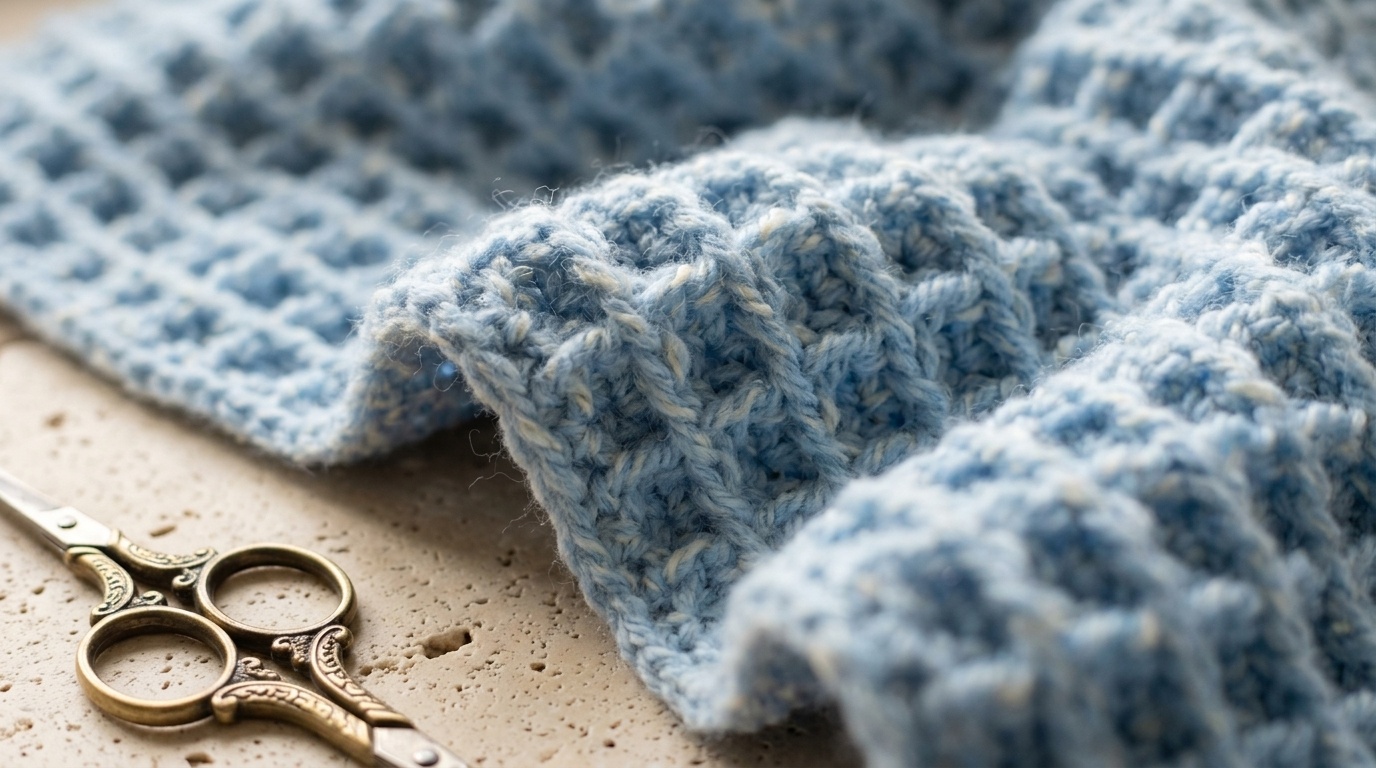
Because the waffle stitch relies heavily on post stitches that draw working yarn around the stem rather than inserting into top loops, it consumes roughly thirty percent more yarn than basic double crochet. Understanding this structural density allows you to accurately budget your yardage, pick an appropriate hook size to maintain fluid movement, and execute a relaxed border that complements the dimensional center.
FULL-SIZE BLANKET INSPIRATION: Ready to scale up your blanket skills for the living room? Learn how to crochet a chunky basketweave throw blanket with 12-stitch post blocks and a framing border.
Maker’s Project Blueprint: Yardage, Hook Size & Tested Gauge

To produce a standard crib or stroller blanket measuring approximately 36 inches wide by 45 inches long (91.5 x 114.5 cm), gather the following tested supplies:
- Yarn: 1,550 yards (approx. 560 grams) of lightweight Category 3 or light worsted Category 4 acrylic-nylon blend (such as Bernat Baby Coordinates or Caron Simply Soft). Soft sky blue, oat cream, or muted sage create timeless modern aesthetics.
- Crochet Hook: 5.5 mm (US Size I-9). Going up one half-size from the manufacturer’s suggested 5.0 mm hook prevents post stitches from puckering the fabric into a stiff mat.
- Notions: Steel blunt tapestry needle for seamless tail weaving, four locking stitch markers to mark edge turns, and sharp embroidery scissors.
- Tested Gauge: Exactly 13 stitches and 14 rows in established waffle stitch pattern = 4 inches (10 cm). Meeting this gauge ensures your finished blanket finishes within 1 inch of specified measurements.
Fiber Selection: Soft Acrylic Blends vs Pure Cotton for Heavy Drapes
Selecting the proper fiber composition dictates whether your blanket remains soft and pliable after repeated machine washings or turns stiff and unmanageable:
Maker’s Fiber Comparison for Waffle Blankets
- Acrylic-Nylon Microfiber Blends (Recommended): Delivers maximum thermal insulation with minimal weight. The synthetic core maintains elasticity, meaning the deep waffle cells rebound back into shape after stretching over crib mattresses.
- 100% Unmercerized Cotton: As shown in our studio tests on cotton vs acrylic yarn properties, cotton creates crisp stitch ridges but adds substantial physical weight. A cotton waffle blanket of this size weighs over 2.5 pounds, which can stretch out excessively under its own bulk when hung.
- Superwash Merino Wool: Luxurious and naturally temperature-regulating, but requires dedicated hand washing or delicate cycles to avoid permanent felting of raised post ridges.
The Waffle Stitch Geometry & Row-by-Row Sequence

The mathematical foundation of the waffle stitch operates on a stitch multiple of 4 + 1, plus 4 extra chains for the turning chain foundation:
- Foundation Chain: Chain 113 loosely (108 + 1 + 4). If your foundation chains tend to pull tight, work this starting chain with a 6.0 mm hook, then switch back to 5.5 mm for Row 1.
- Row 1 (Foundation Row – RS): Work 1 double crochet (dc) in the 4th chain from the hook (the skipped 3 chains count as your first dc). Work 1 dc in each chain across to the end. Turn. (Total: 111 dc).
- Row 2 (Establish Waffle Grid): Chain 3 (counts as first dc). Work 1 front post double crochet (FPDC) around each of the next 2 stitches. Work 1 back post double crochet (BPDC) around the next stitch. *Work 1 FPDC around each of the next 3 stitches, then 1 BPDC around the next stitch. Repeat from * until 3 stitches remain. Work 1 FPDC around each of the next 2 stitches, then work 1 dc into the top of the turning chain. Turn.
- Row 3 (Opposing Recessed Row): Chain 3. Work 1 dc in each of the next 2 stitches. *Work 1 FPDC around the next stitch, then work 1 dc in each of the next 3 stitches. Repeat from * across to the final 3 stitches. Work 1 FPDC around the next stitch, then 1 dc in the final stitch and 1 dc in the top of the turning chain. Turn.
- Row 4 (Grid Alignment): Repeat Row 2. The alignment of FPDC columns stacked directly above previous rounds begins locking the neat square cells into place.
- Repeat Rows 3 & 4: Continue alternating Row 3 and Row 4 until the blanket measures approximately 45 inches (approx. 156 total rows), ending cleanly on a Row 4 repeat. Fasten off and leave a 10-inch tail for weaving.
Tension Secrets & How to Prevent Curling Edges on Setup Rows
Because post stitches pull downward more forcefully than normal top-loop stitches, waffle blankets frequently suffer from edge curvature. Here is how to keep your piece symmetrical:
- The Turning Chain Height Trick: Many crafters struggle with gap holes along the perimeter. Instead of a loose 3-chain turn, try using a “stacked single crochet” (work 1 sc into the first stitch, then work a second sc directly into the vertical left leg of the first sc). This mimics the solid density of a post stitch and eliminates hollow edge loops.
- Relax the Front-Post Draw: When drawing up the initial loop for each FPDC, pull your hook upward slightly so the loop reaches the exact working height of your current row. If you keep the loop choked tight against the post, the entire row contracts horizontally, resulting in hourglass-shaped edges.
- Edge Stitch Counting: Place a locking stitch marker on the turning chain of every 10th row. Waffle stitch edges can trick the eye; it is easy to accidentally skip the final dc in the turning chain, causing you to lose 1 stitch every few rows.
Custom Sizing Matrix: From Stroller Blanket to Crib & Throw
If you want to resize this design for different nursery needs or adult living room lapghans, use our tested calculation matrix:
Waffle Stitch Blanket Sizing Chart
| Size Purpose | Finished Dimensions | Starting Chain (Multiple 4 + 5) | Approx. Yardage |
|---|---|---|---|
| Security / Stroller | 24″ x 30″ | Ch 77 (73 sts) | 750 yards |
| Crib / Baby (Tested) | 36″ x 45″ | Ch 113 (111 sts) | 1,550 yards |
| Toddler Bed | 40″ x 55″ | Ch 129 (127 sts) | 2,100 yards |
| Adult Throw / Lapghan | 50″ x 65″ | Ch 161 (159 sts) | 3,200 yards |
Washing, Steam Blocking & Modern Nursery Styling Coordinates

Because post stitches store substantial dimensional memory, proper finishing transforms a slightly wavy fresh project into a pristine heirloom:
- Gentle Steam Blocking: Pin the corners and outer edges of your blanket to interlocking foam blocking tiles using stainless steel T-pins, ensuring edges are completely square. Hover a garment steamer 1 to 2 inches above the acrylic fibers, allowing steam to soften the yarn without touching the hot iron plate to the surface. Allow to dry completely for 4 hours.
- Laundering Instructions: Wash on gentle cycle with cold water using a mild fragrance-free baby detergent. Tumble dry on low heat with clean wool dryer balls to fluff the waffle ridges back to life. Never use fabric softener, which coats synthetic fibers and reduces breathable air circulation.
- Coordinating Handcrafted Home Decor: Complete your nursery or living room styling with our tested chunky crochet blanket tutorial or organize nursery essentials with our modern crochet hanging basket pattern.
- Edge Troubleshooting: If your border still feels uneven after blocking, explore our diagnostics guide on why crochet edges look uneven for step-by-step remedies.
- The Gathering Bridge: When preparing welcoming guest rooms or welcoming new families to your home, coordinate cozy guest textiles with Claire Montgomery’s hosting advice in our relaxed weekend brunch entertaining guide.
Save This Waffle Stitch Crochet Blanket Pattern to Pinterest
Pin This Heirloom Blanket Blueprint to Your Crochet Board
Create a cozy, textured baby blanket with proven post stitch mechanics and straight borders. Save this pattern to your Crochet Baby Blanket Patterns, Modern Crochet Home Decor, or Free Crochet Patterns boards on Pinterest so you have the gauge chart, stitch calculations, and row repeats ready whenever you need them.
Leave a Comment