
A well-crafted kitchen towel is the hardest working textile in the entire house. Between drying clean dinner plates, wiping damp hands, and sitting on display over an oven handle, standard thin cotton towels often soak through quickly and lose their shape. Learning how to crochet a modern kitchen towel allows you to craft a thick, absorbent hand towel using textured cotton stitches that dry glassware without leaving fuzzy lint behind.
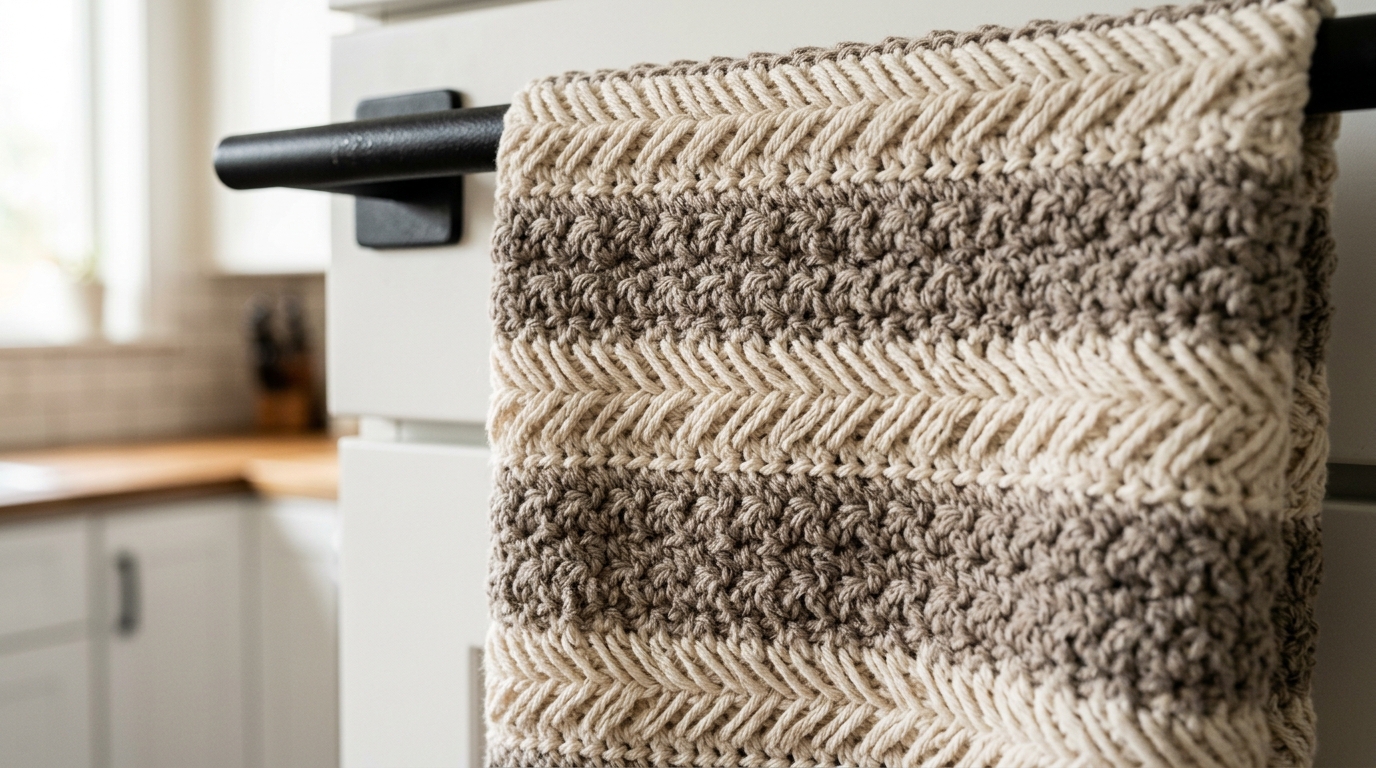
Unlike wearable crochet that requires drape and stretch, kitchen towels need dimensional stability, balanced density, and quick drying performance. By combining relaxed Herringbone Half Double Crochet with compact linen stitch sections, this pattern produces a flat, non-curling rectangular towel with clean modern lines that complements neutral, organic kitchen spaces.
📋 Maker’s Project Blueprint & Specs
| Skill Level: | Beginner / Advanced Beginner |
| Finished Dimensions: | 14 inches wide x 20 inches long (35 x 51 cm) after blocking |
| Yarn Requirements: | ~210 yards (192 m) worsted weight (Medium 4) 100% unmercerized cotton (approx. 2 x 50g balls or 1 x 100g cake) |
| Hook Size: | US H/8 (5.0 mm) ergonomic wooden or aluminum hook |
| Gauge: | 14 sts x 11 rows = 4 inches (10 cm) in Herringbone HDC |
| Completion Time: | 1 hour 45 minutes |
“Pattern tested & hooked by Julian Brooks in my home studio. I tested two test pieces using Dishie worsted cotton across everyday kitchen tasks, dish drying, and 12 warm machine wash cycles. The herringbone stitch angle creates a flat, reversible fabric that helps maintain its shape under regular everyday washing without sagging. Working with a 5.0 mm hook rather than a smaller 4.0 mm keeps the cotton fabric pliable rather than stiff, allowing it to dry thoroughly on an oven rail between kitchen uses.” — Julian Brooks, Home Living & Hands-On DIY Editor
KITCHEN FIBER CARE: Maintain maximum absorbency and keep cotton kitchen textiles odor-free with our cotton dishcloth and towel washing guide tested through 15 complete laundry cycles.
Why Handmade Cotton Towels Work Better
- Lint-Free Glassware Drying: Unlike microfiber towels that attract and shed tiny synthetic fibers, 100% unmercerized cotton dries delicate wine glasses and ceramic mugs cleanly without residue.
- Substantial Moisture Capacity: Natural cotton fibers absorb up to 27 times their dry weight in liquid, handling large post-dinner cleanup sessions with ease.
- Balanced Heat Buffer: In a pinch, the thick textured ridges provide enough thermal insulation to move a warm baking tray safely across countertops. For handling sizzling cast iron pans straight from high heat, always rely on our double thick crochet potholder.
- Simple Machine Care: Cotton fibers soften with each wash cycle while retaining structural density, providing reliable kitchen service for months of everyday cooking.
Materials & Tools

- Yarn: ~210 yards of worsted weight (Medium 4) 100% unmercerized kitchen cotton. Dishie (KnitPicks), Lily Sugar ‘n Cream, or Lion Brand 24/7 Cotton are ideal tested choices. For fiber comparisons, review our testing guide on the best cotton yarns for crochet home projects.
- Crochet Hook: US H/8 (5.0 mm). A smooth wooden or ergonomic hook prevents hand fatigue over long rows.
- Tapestry Needle: Large-eye blunt metal needle for cleanly weaving in ends.
- Measuring Tape: To verify your foundation chain width matches the 14-inch target.
- Optional Leather Hanging Strap: A 4-inch strip of genuine leather or folded cotton cord for clean hanging on cabinet knobs.
Crochet Abbreviations (US Terms)
- Ch: Chain
- SC: Single Crochet
- HDC: Half Double Crochet
- HHDC (Herringbone Half Double Crochet): Yarn over, insert hook in next stitch, yarn over and draw loop through stitch AND through the first loop on your hook (2 loops remain on hook). Yarn over and draw through remaining two loops.
- Sl St: Slip Stitch
- St(s): Stitch(es)
Step-by-Step Modern Kitchen Towel Pattern
Part 1: Foundation & Bottom Hem
Foundation: Chain 49 loosely with Color A (Cream). (To adjust width, use any odd chain count).
Row 1 (Setup Row): Work 1 SC in the 2nd chain from your hook. Work 1 SC in each chain across to the end. You will have 48 stitches total. Turn your work.
Rows 2 to 4 (Sturdy Hem): Ch 1 (does not count as a stitch), SC in each stitch across. Turn. Working four initial rows of single crochet creates a firm lower hem that prevents the bottom edge from curling inward.
Part 2: The Herringbone Texture Body
The Herringbone Half Double Crochet (HHDC) produces a distinct slanted stitch pattern that mirrors woven linen. Alternating turning rows creates an elegant chevron texture across the towel surface. For more relief options, check out our guide to the 8 best textured crochet stitches for modern home decor.

Row 5: Ch 1, work 1 HHDC in the very first stitch and in each stitch across (48 sts). Turn your work.
Rows 6 to 18: Repeat Row 5 with Color A (Cream).
Rows 19 to 24 (Color Stripe): On the final yarn over of Row 18, switch to Color B (Warm Taupe). Ch 1, work HHDC across each row for 6 rows.
Rows 25 to 48 (Center Section): Switch back to Color A (Cream). Work HHDC across each row for 24 rows.
Rows 49 to 54 (Accent Stripe): Switch to Color B (Warm Taupe). Work HHDC across each row for 6 rows.
Rows 55 to 68 (Upper Section): Switch to Color A (Cream). Work HHDC across each row for 14 rows.
Part 3: Top Hem & Integrated Hanging Loop
A matching single crochet hem balances the top edge and provides a secure foundation for a hanging loop.
Rows 69 to 72: Ch 1, work 1 SC in each stitch across (48 sts). Turn.
Corner Hanging Loop: On the final row, do not fasten off. In the top corner, work 1 SC, chain 14 loosely, and slip stitch back into the base of the chain to create a strong loop for hanging. Fasten off leaving a 6-inch tail. Weave in all color-change yarn tails securely along the wrong-side ridge lines using your tapestry needle.
How to Keep Kitchen Towels Hanging Flat

Handmade crochet towels can sometimes pull inward along the selvedge edges if tension varies across rows. Here is how to ensure your towel hangs square and straight:
- Steam Blocking Makes a Noticeable Difference: Pin your completed towel to foam blocking mats at exact 14 x 20-inch dimensions using stainless T-pins. Hover a steam iron 1 inch above the fabric without touching the yarn. Let it dry completely for 4 hours. For more edge-straightening strategies, read our guide on why crochet curls and 7 practical fixes.
- Coordinate with Matching Kitchen Linens: Pair your kitchen towel with our textured modern crochet dishcloth in matching cream and taupe tones to create an organic, unified sink station.
- Add a Simple Leather Hanging Tab: If you prefer hanging your towel from a small wall peg or cabinet knob, fold a 1/2-inch wide leather strap over the center top edge and secure it with a brass rivet or sturdy whip stitch.
Care & Laundering Guide
- Washing Temperature: Machine wash in warm or hot water with regular laundry detergent. 100% cotton can handle everyday sanitizing washes without degrading.
- Skip Fabric Softener: Chemical liquid softeners coat cotton fibers in a silicone film that reduces water absorbency by up to 40%. Use 1/2 cup of distilled white vinegar in the rinse dispenser instead to keep towels soft and absorbent.
- Drying: Tumble dry on medium heat. Tumble drying helps fluff the herringbone ridges and restores natural grip.
Frequently Asked Questions
What is the best crochet stitch for an absorbent kitchen towel?
The Herringbone Half Double Crochet and Moss Stitch are top choices. Both create closed, even fabric that catches water droplets immediately while remaining flexible enough to dry inside drinking glasses.
Can I make this towel with acrylic yarn?
No. Acrylic yarn is made from plastic fibers that do not absorb water; moisture simply beads up and slides off the surface. Always use 100% unmercerized kitchen cotton for functional kitchen towels.
How many skeins of cotton yarn do I need?
You need approximately 210 yards (192 meters) of worsted cotton. That equals roughly two 50g balls or one large 100g skein of cotton like Dishie or Sugar ‘n Cream.
Why are the sides of my towel narrowing as I crochet?
Accidentally dropping the very last stitch at the end of a row is the most common cause. Count your 48 stitches every 5 to 6 rows to ensure your towel maintains a uniform 14-inch width from bottom to top.
Save This Pattern on Pinterest
Ready to upgrade your kitchen linens with practical handmade texture? Pin this easy crochet kitchen towel pattern to your Pinterest DIY and home craft boards so you have the instructions ready!
Just finished mine while watching a movie this evening!! Row 4 had me second-guessing my stitch count at first, but once I saw how the texture lined up, it was so relaxing to work up. Laying it out on my side table right now!
Haha that’s the best way to craft! Row 4 is usually where the rhythm clicks into place. So glad it’s looking lovely on your side table—enjoy your new piece!