
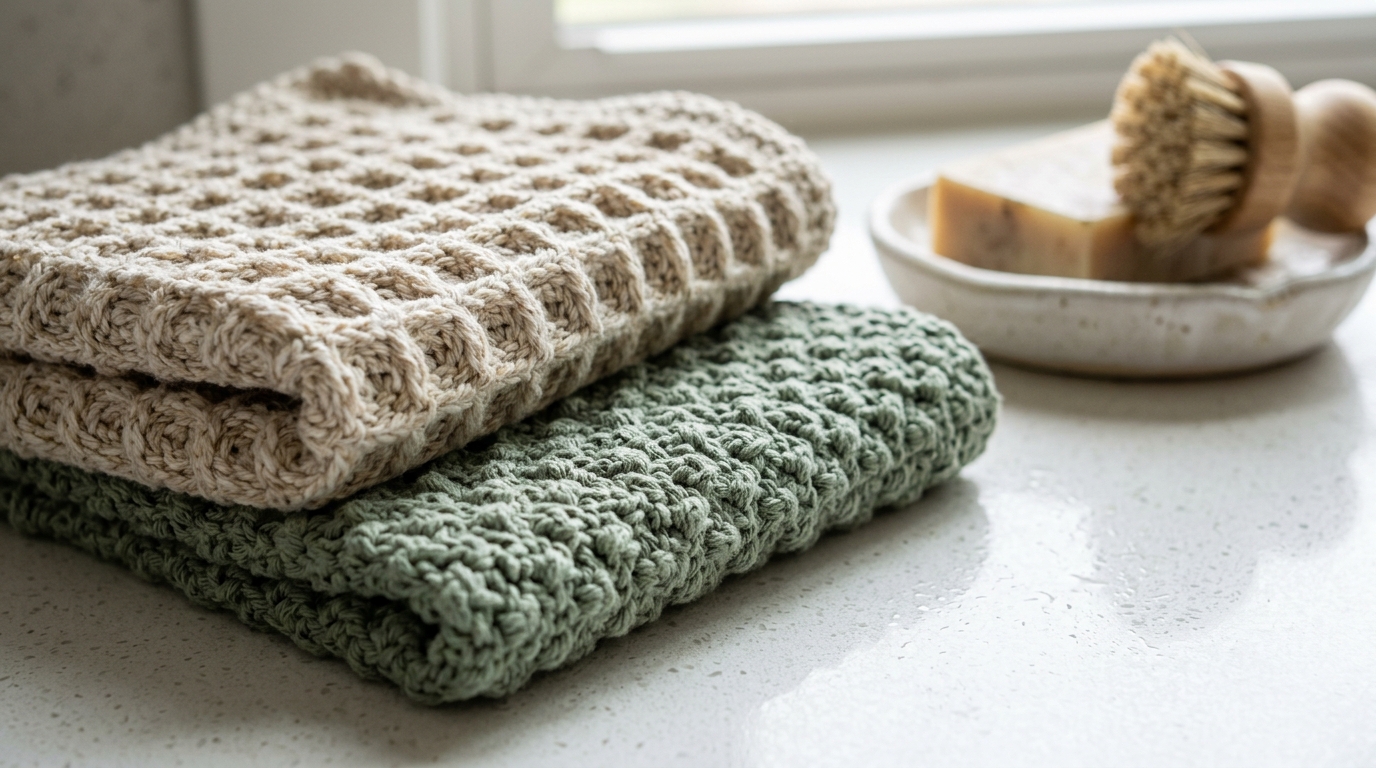
Few handmade items get more daily mileage in a busy kitchen than a thick, textured dishcloth. While store-bought synthetic sponges trap grease and wear down quickly, learning how to crochet a modern textured dishcloth gives you durable, washable kitchen linens with raised ridges that scrub away stuck-on food without scratching delicate nonstick cookware or ceramic sinks.
Planning to swap yarns? Discover why synthetic fibers fail on countertops in our objective testing guide: Cotton vs Acrylic Yarn for Kitchen Crochet (Tested).
Unlike flat single crochet that can feel limp when wet, pairing alternating loop placements with thick worsted cotton creates structured, textured channels that hold soap lather and wipe counters cleanly. This project works up in roughly 35 minutes, making it an ideal weekend stash-buster and a practical handmade gift.
📋 Maker’s Project Blueprint & Specs
| Skill Level: | Beginner / Advanced Beginner |
| Finished Dimensions: | 8.25 x 8.25 inches (21 x 21 cm) square after blocking |
| Yarn Requirements: | ~75 yards (68 m) worsted weight (Medium 4) 100% unmercerized cotton |
| Hook Size: | US H/8 (5.0 mm) ergonomic crochet hook |
| Gauge: | 15 sts x 13 rows = 4 inches (10 cm) in stitch pattern |
| Completion Time: | 35 to 40 minutes per dishcloth |
“Pattern tested & hooked by Julian Brooks in my home studio. To test real-world performance, I ran three sample cloths through 15 kitchen wash and dry cycles using hot water and tumble drying. Unmercerized cotton shrinks about 3% initially, tightening the textured ridges for even better scrubbing grip. Avoid synthetic fibers like polyester or acrylic here—they do not absorb water effectively and can soften or degrade against warm kitchen surfaces.” — Julian Brooks, Home Living & Hands-On DIY Editor
LAUNDRY & CARE PROTOCOL: Wondering how to keep your textured dishcloth soft and odor-free through dozens of kitchen uses? Follow our tested 15-wash handmade dishcloth care guide with water temperature guidelines and vinegar rinse tips.
Why Textured Cotton Outperforms Store-Bought Sponges
- Empirical Water Absorption: Quality 100% unmercerized cotton absorbs roughly 24 to 27 times its dry weight in water, allowing you to wipe down wet quartz countertops with fewer passes.
- Non-Abrasive Scrubbing Power: The alternating front-post and ridge stitches create tactile bumps that lift stubborn grease without scratching nonstick cookware coatings or polished stainless steel.
- Machine Washable & Sanitizable: Unlike cellulose sponges that harbor moisture and bacteria, cotton dishcloths can be washed weekly in hot water and tumble dried with kitchen towels.
- Eco-Friendly Kitchen Routine: One set of four handmade cloths replaces dozens of disposable sponges each year, creating a clean, minimal sink station.
Materials & Tools

- Yarn: 1 ball (approx. 50g / 1.75oz) of worsted weight 100% unmercerized kitchen cotton. Dishie by KnitPicks, Scheepjes Cahlista, or Lily Sugar ‘n Cream are tested studio favorites. For an in-depth yarn comparison, review our lab guide on the best cotton yarns for crochet home projects.
- Crochet Hook: 5.0 mm (US H/8). A smooth wooden or ergonomic metal hook helps you work through dense cotton without wrist fatigue.
- Tapestry Needle: Blunt metal needle for weaving in tails cleanly.
- Measuring Tape: To verify your starting foundation chain matches your desired width.
Crochet Abbreviations (US Terms)
- Ch: Chain
- SC: Single Crochet
- HDC: Half Double Crochet
- Sl St: Slip Stitch
- St(s): Stitch(es)
- BLO: Back Loop Only
- FLO: Front Loop Only
Step-by-Step Modern Dishcloth Pattern
1. Foundation Chain & Base Row
Foundation: Chain 29 loosely. (To customize dimensions, use any odd number of chains).
Row 1: Work 1 Half Double Crochet (HDC) into the 3rd chain from your hook (the skipped 2 chains count as your first HDC). Work 1 HDC into each chain across the row. You should have 28 stitches total. Turn your work.
2. Building the Scrubbing Ridge Texture
The scrubbing texture is created by alternating between the Front Loop Only (FLO) and Back Loop Only (BLO) on alternating Half Double Crochets. This pushes horizontal yarn bars forward, creating tactile scrubbing ribs on both sides of the cloth.
Row 2: Ch 1 (does not count as a stitch). Work 1 HDC in the Front Loop Only (FLO) of the first stitch. Work 1 HDC in the Back Loop Only (BLO) of the next stitch. *HDC in FLO of next st, HDC in BLO of next st*. Repeat from * across the entire row, ending with 1 regular HDC through both loops of the final stitch to keep the outer edge straight. Turn your work.

Rows 3 to 24: Repeat Row 2 until your piece measures approximately 7.75 inches (20 cm) from the foundation edge, ending on an even-numbered row. For more textured relief variations, explore our directory of the 8 best textured crochet stitches for modern home decor.
3. Adding the Perimeter Border & Hanging Loop
A tidy single crochet border locks down the edge tension, preventing the sides from rippling. If you have ever experienced curved edges on small home projects, review our troubleshooting guide on why crochet curls and 7 simple fixes.
Border Round: Do not turn after Row 24. Ch 1, work 1 SC in the same corner space. Work single crochets evenly down the left raw edge (aim for 1 SC per row end, roughly 24 SC). In the corner, work (1 SC, ch 2, 1 SC) to turn neatly.
Work 1 SC into each unworked loop along the starting foundation chain across the bottom edge. In the next corner, work (1 SC, ch 2, 1 SC).
Work single crochets evenly up the right raw edge. In the corner, work (1 SC, ch 2, 1 SC). Work 1 SC across the top edge stitches.
Optional Hanging Loop: In the final corner, work 1 SC, chain 10, slip stitch into the base of the chain to form a loop, then work 1 SC into the same corner space. Join with a slip stitch to your first border SC. Fasten off and weave in all yarn ends with your tapestry needle.
Care & Washing Instructions

Taking proper care of handmade kitchen cotton keeps it fresh and odor-free for months of heavy cooking:
- First Wash Setting: Wash new cloths in warm water with similar colors. Cotton dye can release minor excess color during the first laundering cycle.
- Regular Kitchen Laundering: Launder weekly in warm or hot water with standard laundry detergent. For deep sanitization, add 1/2 cup of distilled white vinegar to the rinse cycle to naturally dissolve detergent residues.
- Drying: Tumble dry on medium heat or lay flat across a drying rack. Tumble drying fluffs the cotton fibers and restores the scrubbing texture.
- Pair with Coordinating Kitchen Linens: To build a cohesive handmade kitchen collection, pair these cloths with our double thick crochet potholder in matching natural earth tones.
Frequently Asked Questions
What is the best stitch for a crochet dishcloth?
The alternating front-loop and back-loop Half Double Crochet (used in this pattern), the Moss Stitch, and the Waffle Stitch are the most effective. They create raised ridges that trap soap lather and scrub efficiently without creating holes where silverware can poke through.
How many yards of yarn do I need for one dishcloth?
A standard 8×8 inch square dishcloth requires approximately 70 to 80 yards (64–73 meters) of worsted weight cotton yarn. One standard 100g skein of kitchen cotton yields two full dishcloths with enough yarn left over for hanging loops.
Can I use mercerized cotton for dishcloths?
While mercerized cotton has a pretty sheen, it is treated with caustic chemicals that compress the fibers, reducing its water absorption capacity by about 30%. Unmercerized matte kitchen cotton is far more absorbent and better suited for wiping counters and washing dishes.
Why does my square dishcloth look like a trapezoid?
Uneven sides usually happen from accidentally skipping the very first stitch or missing the final turning chain stitch at the end of each row. Counting your 28 stitches every few rows ensures straight vertical edges from start to finish.
Save This Pattern on Pinterest
Ready to hook your own set of modern kitchen dishcloths? Save this free crochet pattern to your Pinterest DIY and home craft boards for your next weekend project!
Just finished mine while watching a movie this evening!! Row 4 had me second-guessing my stitch count at first, but once I saw how the texture lined up, it was so relaxing to work up. Laying it out on my side table right now!
Haha that’s the best way to craft! Row 4 is usually where the rhythm clicks into place. So glad it’s looking lovely on your side table—enjoy your new piece!
Such a clear pattern! I made mine with dishie cotton in a soft sage green. Worked up in about 45 minutes while sitting on the porch. Love how practical and sturdy it is!
Sage green sounds gorgeous for this piece! 45 minutes is great speed, and kitchen cotton just gets softer with every wash. Happy hooking!