
If finger cramps or wrist stiffness have ever interrupted a project, upgrading to a high-end ergonomic hook is the single most effective adjustment you can make. In the fiber arts community, the choice between Clover Amour vs Tulip Etimo remains the gold standard debate. Both represent premier Japanese engineering—pairing medical-grade elastomer handles with precision aluminum shafts—yet they offer fundamentally different ergonomic architectures. In this hands-on test, we compare the Clover Amour H/8 5.0mm directly against the Tulip ETIMO Gold 8/0 5.00mm, evaluating handle dimensions, hook head geometry, yarn glide, and long-session stamina on identical cotton test swatches.
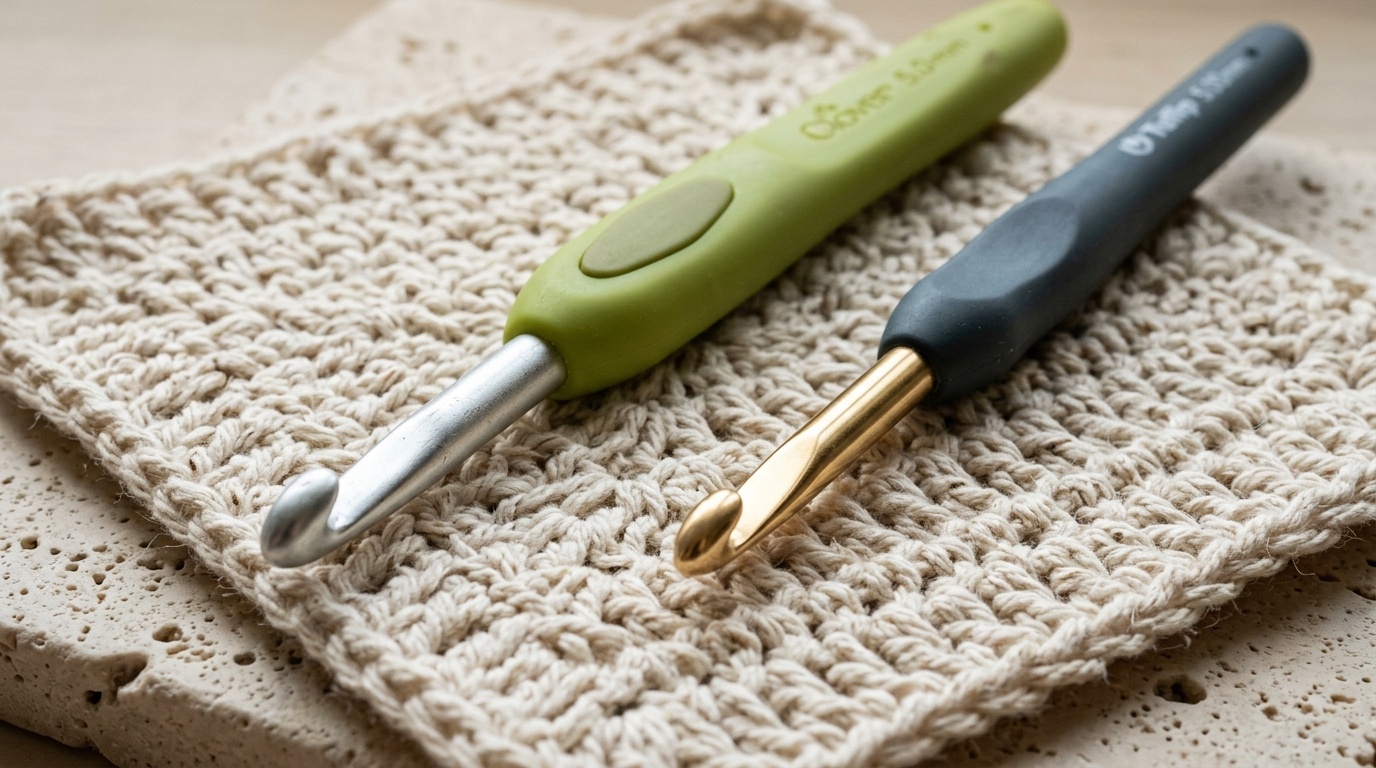
Clover Amour vs Tulip Etimo: Which One Wins?
- Best Overall: Tulip ETIMO Gold 8/0 5.00mm — Its polished gold shaft provides exceptionally smooth yarn travel, and its deeper undercut throat holds loops securely during brisk stitching.
- Best Grip: Split Decision — Tulip ETIMO Gold excels for knife-grip crafters needing rounded palm support; Clover Amour excels for pencil-grip crafters relying on a broad flat thumb pad.
- Smoothest Yarn Glide: Tulip ETIMO Gold — Delivers noticeably smoother-feeling yarn travel during the cotton swatch comparison.
- Best for Beginners: Clover Amour H/8 5.0mm — Distinct handle colors make identifying sizes intuitive, and its rounded blunt tip guards against split plies.
- Best for Cotton Yarn: Tulip ETIMO Gold — Glides cleanly through high-drag unmercerized cotton with minimal pulling resistance.
- Best Value: Clover Amour — Noticeably lower retail pricing per hook, especially when purchased in 10-piece sets.
Unlike generic ergonomic hooks whose loose silicone sleeves twist under pressure, both Clover and Tulip mold their elastomer handles directly to the metal core. However, because their throat profiles and handle contours target different grips and yarn types, picking the right model depends on your physical stitching technique.
Clover Amour vs Tulip Etimo at a Glance
To compare their physical builds and tested behaviors directly, the table below separates verified manufacturer specifications from our hands-on studio measurements:
| Specification / Test Parameter | Clover Amour H/8 5.0mm | Tulip ETIMO Gold 8/0 5.00mm |
|---|---|---|
| Manufacturer Specifications | ||
| Exact Tested Model | Clover Amour (Item #1047/H) | Tulip ETIMO Classic Gold (Item #TEG-008e) |
| Size Designation | US H/8 (5.0 mm) | Japanese 8/0 (5.00 mm) |
| Handle Material | Elastomer rubber with flat thumb indent | Elastomer rubber with continuous 3D contour |
| Hook Core & Finish | Aluminum with satin-matte silver anodizing | Aluminum with mirror-polished gold anodizing |
| Total Length | 140 mm (5.5 inches) | 140 mm (5.5 inches) |
| Studio Measurements & Observations | ||
| Handle Diameter (Caliper) | 12.4 mm widest (6.2 mm at thumb rest) | 13.8 mm widest (7.1 mm at thumb rest) |
| Shaft Length to Grip | 39.5 mm usable metal | 41.2 mm usable metal (+1.7 mm clearance) |
| Head & Throat Profile | Semi-inline, rounded blunt tip, shallow curve | Hybrid tapered-inline, sharper tip, deep undercut |
| Yarn Glide Quality | Controlled, smooth glide with slight tactile hold | Ultra-slick; noticeably smoother on cotton fibers |
| Best Grip Orientation | Pencil grip (flat thumb pad prevents rotation) | Knife grip (barrel contours into the palm hollow) |
| Best Application | Beginner kits, loosely plied yarns, pencil grip | Dense cotton projects, tight stitches, knife grip |
| Primary Limitation | More drag on grabby cotton; pastel handles soil | Higher price point; requires care on splitty yarn |
Testing Parameters: Same Hook, Same Yarn, Same Hands

To eliminate subjective bias and evaluate mechanical differences objectively, we standardized our studio testing environment:
- Standardized Diameter: Both hooks were tested in the 5.0 mm diameter—the workhorse size for worsted cotton home decor projects like our easy modern crochet coasters.
- Identical Fiber Batch: Every test row used 4-ply unmercerized ecru cotton from the same dye lot under 68°F (20°C) ambient studio conditions. Cotton was selected because its lack of natural bounce quickly reveals hook friction.
- Standardized Swatch Pattern: Each tool produced a 4.0-inch square swatch worked over 18 stitches by 16 rows, combining single crochet rows with textured half-double crochet passes.
- Multi-Day Rest Protocol: We completed two 45-minute continuous hooking sessions separated by a 24-hour rest window. Testing order was inverted on Day 2 (Day 1: Tulip then Clover; Day 2: Clover then Tulip) to cancel out cumulative forearm fatigue.
Hook Head & Throat Comparison: Rounded Semi-Inline vs Precision Undercut

The head profile dictates loop capture and release speed. The macro comparison above highlights four critical differences:
- Tip Sharpness: The Tulip ETIMO Gold has a tapered, slightly sharper nose that slips into tight foundation chains with minimal effort. The Clover Amour features a blunter, domed tip that requires slightly more pushing pressure, but virtually prevents splitting twisted plies.
- Throat Undercut: Tulip uses a defined undercut shelf beneath the lip. When pulling working loops through a dense stitch, the yarn seats deeply in this groove and will not slide off. Clover uses a shallower continuous curve that releases loops effortlessly, though very loose crocheters must maintain steady yarn tension to prevent dropped loops.
- Shaft Clearance: Digital calipers showed the Tulip offers 41.2 mm of usable aluminum from grip to tip versus 39.5 mm on Clover. That 1.7 mm variance provides helpful space when gathering multi-loop clusters or puff stitches.
- Loop Exit Behavior: Stitches slide off Clover’s rounded nose with near-zero drag. Tulip’s deeper lip holds the yarn slightly longer, requiring a clean wrist roll to cast off smoothly.
Handle Shape & Grip: Knife Grip vs Pencil Grip Ergonomics

Your grip style dictates which handle profile delivers better physical support:
- Barrel Thickness: Our calipers recorded Tulip’s widest grip point at 13.8 mm versus Clover’s 12.4 mm. That 1.4 mm difference allows knife-grip crafters to hold the Tulip securely without clenching their palm muscles.
- Thumb Rest Shape: Clover molded a wide, flat thumb depression into its handle. For pencil grippers, this flat plane creates an immovable pivot point between thumb and forefinger. Tulip features a gentler, rounded scoop that accommodates fingers shifting along the shaft.
- Elastomer Feel: Clover uses a slightly tackier, grippy rubber. Tulip uses a smooth, powdery-matte elastomer that stays completely dry during long crafting blocks and resists surface lint.
Which Hook Glides Through Yarn Better? Friction & Speed Tested

Shaft surface finishing directly affects stitching cadence:
- Tulip ETIMO Gold (Mirror Finish): Its polished gold anodized aluminum has virtually zero surface drag. It produces noticeably smoother-feeling yarn travel during the cotton swatch comparison, reducing resistance on each stitch.
- Clover Amour (Satin-Matte Finish): Clover’s bead-blasted silver surface offers plenty of glide, but maintains a subtle micro-texture that gives extra control when working with slippery fibers like silk or bamboo.
- Stitching Pace: Across timed 100-stitch rows, the Tulip completed passes slightly faster because loops catch and advance with less physical drag.
Which Is Better With Cotton Yarn? High-Drag Fiber Assessment
Because cotton lacks natural elasticity and possesses high surface grab, it quickly exposes tool friction. When stitching dense kitchen cotton—like the yarns in our best cotton yarns for crochet coasters test—the tools performed as follows:
- Drag Reduction: The Tulip ETIMO Gold is our preferred choice for cotton. Its mirror-like finish pulls through tight stitch columns with minimal pulling effort.
- Split Prevention: If working with loosely plied cotton cords, the Clover Amour provides extra safety. Its rounded nose pushes past plies without splitting between individual strands.
- Fiber Dynamics: To understand how fiber elasticity affects wrist strain, see our laboratory study on cotton vs acrylic yarn for kitchen crochet.
Comfort During Longer Crochet Sessions: The 45-Minute Fatigue Test

Julian recorded these direct observations immediately following timed 45-minute continuous stitching blocks:
- Tulip ETIMO Gold (45 Minutes): The palm heel and forearm tendons remained relaxed. Because the 13.8 mm barrel fills the palm, fingers never tensed into a tight pinch. The matte elastomer stayed cool and dry throughout.
- Clover Amour (45 Minutes): Alignment between thumb and index finger remained rock-solid on the flat pad. In knife grip, however, the flatter rear taper provided less palm contact, resulting in minor pinky tension toward the end of the session.
- Wrist Tendon Load: Tulip’s slicker shaft required less physical pulling force on return passes, resulting in noticeably less fatigue across the wrist joint.
Clover Amour vs Tulip Etimo for Beginners: Which Should You Start With?
If you are a newcomer starting your maker journey with our modern crochet beginner roadmap, the Clover Amour is the practical starter recommendation for three reasons:
- Color-Coded Handles: Each Clover size features an unmistakable handle color (e.g., 5.0 mm is lime green, 5.5 mm is dark green, 6.0 mm is cyan). You can identify the right hook instantly across a room without checking tiny engravings. Tulip ETIMO Gold uses uniform grey handles with printed gold markings.
- Forgiving Tip: New crocheters often struggle with uneven tension; Clover’s rounded tip glides into stitches without splitting loose yarn plies.
- Accessible Pricing: At roughly half the cost of a full Tulip set, Clover delivers professional ergonomics at an approachable entry price.
Available Hook Sizes & Sets: Full Kits vs Individual Upgrades
Both manufacturers offer comprehensive size lineups:
Tool Range & Packaging Overview
- Clover Amour Lineup: Available from 0.60 mm steel lace hooks up to 15.0 mm jumbo sizes. The popular 10-piece aluminum set includes 2.25 mm (B) through 6.0 mm (J), sold in a clear blister pack without a storage case.
- Tulip ETIMO Lineup: Available in ETIMO Classic Gold (tested here), ETIMO Rose (pink gradient handles), and ETIMO Red (matte crimson shaft and handles for dark yarn contrast). The standard 8-piece kit (2.0 mm to 6.0 mm) includes a premium tweed zip case, yarn needles, and scissors.
- Open Stock: Both brands sell single hooks individually, allowing you to test a 5.0 mm hook before investing in a full collection.
Price & Value: Is Clover Amour or Tulip Etimo Worth the Money?
Quality tools outlast dozens of yarn projects. Here is the cost perspective (Verified as of October 2026):
- Clover Amour: Individual hooks retail around $8.50 to $10.50 USD; full 10-hook sets sell for $55 to $75 USD (often discounted with craft retail coupons below $45 USD).
- Tulip ETIMO Gold: Individual hooks retail around $13.00 to $16.50 USD; the complete 8-hook boxed set with fabric travel case sells for $95 to $130 USD.
- Value Verdict: If you crochet more than 5 hours weekly, prefer a knife grip, or work heavily with cotton, Tulip’s palm comfort and mirror glide justify the $35-$45 set premium. For all-around crafting and pencil-grip makers, Clover delivers exceptional performance per dollar.
Who Should Choose Clover Amour?
- You hold your hook in a pencil grip and want a stable flat thumb pad.
- You want an affordable starter set under $60 with professional-grade elastomer.
- You prefer color-coded handles for instant size identification across your craft basket.
- You work with splitty, loosely twisted acrylic or wool blends where a rounded tip prevents snags.
Who Should Choose Tulip Etimo?
- You hold your hook in a knife grip and benefit from a thicker 13.8 mm rounded barrel.
- You frequently stitch unmercerized cotton, linen, or stiff kitchen cords and need minimal yarn drag.
- You are a speed crocheter who relies on a deep undercut throat to lock loops on fast pulls.
- You appreciate an all-in-one travel set with a curated zip case and notions.
Pros and Cons Breakdown
Clover Amour H/8 5.0mm
PROS:
- Color-coded handles make identifying sizes instantaneous
- Rounded blunt tip eliminates ply splitting on loose yarns
- Broad flat thumb rest provides exceptional pencil-grip control
- Outstanding price-to-performance ratio
CONS:
- Slightly more drag on unmercerized cotton compared to polished gold
- Light pastel rubber handles can show stains over months of use
- Basic blister packaging lacks a reusable storage case
Tulip ETIMO Gold 8/0 5.00mm
PROS:
- Mirror-polished gold shaft offers unrivaled low-drag glide
- Deep undercut throat locks loops securely during fast passes
- 13.8 mm rounded barrel supports the palm hollow for knife grip
- Full boxed set includes a durable fabric travel case and notions
CONS:
- Premium price point (typically 40% to 50% more than Clover)
- Sharper tip requires attention on loosely spun plies
- Uniform grey handles make picking sizes slower at a glance
Which One Would I Buy? Julian’s Studio Verdict

Both hooks produced identical 4.0-inch square gauge blocks over 18 stitches and 16 rows. If you already own one set, there is rarely a compelling reason to replace it with the other.
However, if buying a single new premium set today, my personal studio choice is the Tulip ETIMO Gold. As a knife-grip maker who spends hours crocheting dense cotton home textiles like our square crab-stitch crochet coasters, the combination of a thicker 13.8 mm palm barrel, deeper undercut throat, and mirror-polished gold shaft creates a fluid cadence that protects my wrists.
If you hold your hook with a pencil grip, or want the best ergonomic upgrade on a reasonable budget, the Clover Amour remains an exceptional, world-class tool that will serve you reliably for decades.
The Gathering Bridge: When spending quiet weekend hours crafting handmade gifts for upcoming hosting, pair your favorite ergonomic hook with Claire Montgomery’s relaxed hosting timeline in our stress-free Friendsgiving potluck guide.
Frequently Asked Questions
Is Tulip Etimo better than Clover Amour?
Tulip ETIMO Gold is mechanically superior for knife-grip crocheters and high-drag cotton fibers due to its thicker rounded barrel, deeper throat, and polished gold shaft. Clover Amour is equally effective for pencil-grip crafters and provides superior value with color-coded handles and a snag-free rounded nose.
Which crochet hook is smoother?
The Tulip ETIMO Gold has a noticeably slicker surface. Its gold anodized aluminum is mirror-polished, whereas the Clover Amour uses a satin-matte silver finish that creates slightly more tactile feedback.
Which one is better for beginners?
Clover Amour is generally better for beginners. Its bright color-coded handles make identifying sizes foolproof, its rounded tip guards against yarn splitting, and it carries a significantly lower entry price.
Which one is better for cotton yarn?
Tulip ETIMO Gold performs noticeably better on unmercerized cotton yarn because its glass-smooth shaft minimizes friction when pulling loops through tight stitches.
Are Clover Amour hooks inline or tapered?
Clover Amour hooks are a hybrid semi-inline design, featuring a smooth, shallow curve with a soft lip and a rounded head that does not overhang the shaft sharply.
Are Tulip Etimo hooks inline or tapered?
Tulip ETIMO Gold hooks are also a hybrid design, leaning slightly closer to tapered with a defined, deep undercut groove beneath the lip and a slightly sharper point.
Is Tulip Etimo worth the extra money?
Yes, if you crochet more than 5 hours per week or frequently use a knife grip with cotton yarn, the reduced wrist fatigue and faster stitch glide justify the $35 to $45 price difference over years of crafting.
Save This Ergonomic Crochet Hook Comparison for Later

Pin This Tool Guide to Your Craft Room Board
Choosing the right ergonomic crochet hook is a long-term investment in your hands and crafting comfort. Save this comparison to your Crochet Tools & Supplies, Beginner Crochet Tips, or Craft Room Essentials boards on Pinterest so you can reference caliper measurements and grip recommendations before purchasing your next set.
This comparison is so helpful! I’ve had terrible wrist fatigue with standard aluminum hooks during longer crochet sessions. Ordered a 5.0mm Clover Amour after reading your grip breakdown and the difference in hand comfort is night and day.
Hi Julian! Between the Clover Amour and the Tulip Etimo, which one has a smoother glide on slightly splitty cotton yarns?
Great question, Elena! The Tulip Etimo has a slightly more polished matte finish on the aluminum throat, which glides through splitty cotton with zero snagging. The Clover is fantastic for wool and acrylic, but for kitchen cotton, Tulip takes the crown!