
A generous floor pouf is one of the most hardworking, versatile furnishings you can add to a living room—serving as an impromptu footrest, casual low seating for family gatherings, or a grounding textural accent beside a coffee table. While store-bought bean bags quickly lose their volume and thin knitted ottomans stretch into saggy puddles, a handcrafted crochet floor pouf built with super bulky yarn and dense half double crochet stitches maintains firm structural integrity for years. By combining concentric circular increase rounds with continuous cylindrical sidewalls, this tested pattern produces a substantial 24×18-inch ottoman that holds its shape under real-world use.
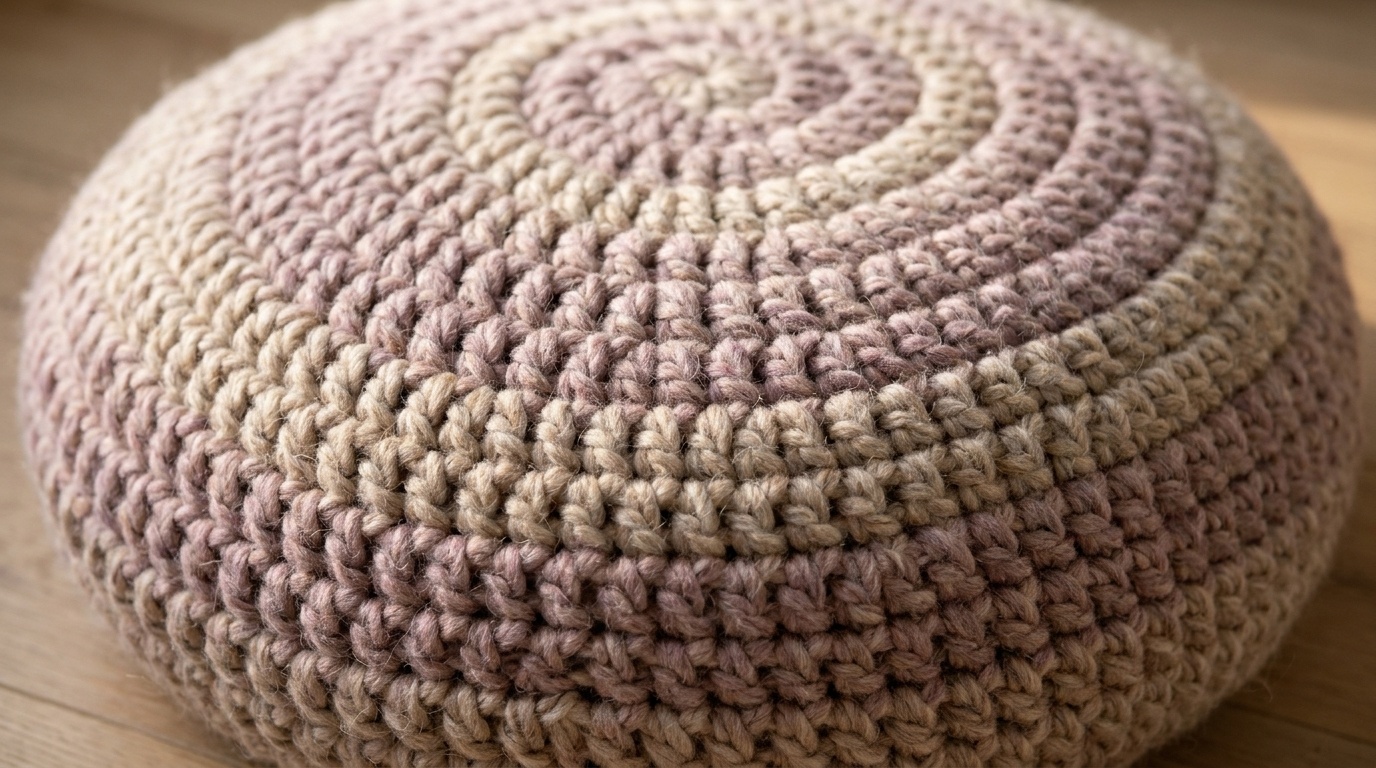
Crocheting three-dimensional floor seating introduces unique structural requirements that standard blankets or pillows never face. A pouf must support body weight without bursting seams, resist friction against wood and carpet fibers, and conceal an internal liner so loose filling never pokes through the stitch gaps. In this workshop blueprint, we work with Category 6 super bulky yarn and an 8.0 mm hook to create a tight, pill-resistant outer shell. Paired with a fabric inner core and dense layering technique, this project delivers an organic modern statement piece that bridges relaxed comfort and durable home craftsmanship.
LIVING ROOM FIBER COORDINATE: Complete your cozy seating corner by pairing your floor pouf with our tested pattern on how to crochet a modern moss stitch blanket in super bulky chenille yarn.
Project Blueprint: Finished Dimensions, Gauge & Super Bulky Yardage
Before casting your starting circle, reviewing the structural parameters and material requirements ensures your pouf achieves balanced proportions and sufficient density to stay upright:
| Pattern Specification | Workshop Tested Standard | Practical Maker Notes |
|---|---|---|
| Finished Dimensions | 24 inches wide × 18–20 inches high (61 × 48–51 cm) | Classic ottoman proportion comfortable for footrest height and low floor seating. |
| Skill Level | Easy / Confident Beginner | Uses basic half double crochet (hdc), circular increases, and simple decreases (hdc2tog). |
| Yarn Requirement | Super Bulky Category 6 (e.g., Caron Tea Cakes, Bernat Blanket, or wool blend) | 5 cakes (approx. 1,020 yards / 930 m total; 240g / 204 yds per cake). |
| Crochet Hook | Size U.S. L/11 (8.0 mm) ergonomic hook | Using an 8.0 mm hook with super bulky yarn creates firm stitches with zero open gaps. |
| Gauge | 7 single crochets × 8 rows = 4 inches (10 cm) (or 8 hdc × 6 rnds) | A tight gauge is essential so the polyester stuffing remains invisible from the outside. |
| Core Stuffing Materials | Inner cotton pillow cover (24–26 in), high-density fiberfill, or recycled fabric scraps | An internal liner bag contains the stuffing and prevents fiber migration through stitches. |
| Additional Tools | Locking stitch marker, large bent-tip yarn needle, sharp shears, tape measure | The stitch marker is vital for tracking the beginning of continuous spiral rounds. |
Yarn Selection: Why Super Bulky Blends Outperform Lightweight Yarns
Selecting the right yarn fiber determines whether your floor pouf stands firm or flattens after a month of lounging. In our workshop trials comparing lightweight worsted yarns held double versus dedicated super bulky singles, Category 6 yarns proved superior across three critical areas:

- Structural Density & Stitch Memory: Super bulky wool-acrylic blends (or chenille tube cores) possess inherent spring and thickness. Each stitch creates a thick, pillowy cushion that rebounds after weight is removed, unlike delicate cotton or fine acrylics that compress permanently under pressure.
- Zero-Gap Shell Protection: Lightweight yarns leave microscopic holes between stitches where white polyester fiberfill can show through. The generous ply of Category 6 yarn interlocks tightly, forming an opaque barrier that keeps all internal stuffing completely concealed.
- Swift Maker Progression: With only 7 stitches per 4 inches, an entire 24-inch floor pouf works up across a weekend of comfortable stitching rather than requiring weeks of tedious fine-gauge labor.
Step-by-Step Construction: Working the Flat Circular Top (Rounds 1–17)
The pouf begins at the top center and expands outward in a flat circle using an 8-stitch per round increase rhythm. Note that the turning chain-2 at the start of each round does not count as a stitch, and every round is joined with a slip stitch to the first true half double crochet:

Foundation: Chain 3 loosely with your 8.0 mm hook.
Round 1: Work 8 half double crochet (hdc) in the 3rd chain from your hook. Join with a slip stitch to the first hdc. (8 hdc total).
Round 2: Chain 2. Work 2 hdc in each hdc around. Join with a slip stitch. (16 hdc).
Round 3: Chain 2. *(Work 2 hdc in next st, 1 hdc in next st)* 8 times. Join. (24 hdc).
Round 4: Chain 2. Work 1 hdc in next st, *(2 hdc in next st, 1 hdc in each of next 2 sts)* 7 times, work 2 hdc in next st, 1 hdc in last st. Join. (32 hdc).
Round 5: Chain 2. *(Work 2 hdc in next st, 1 hdc in each of next 3 sts)* 8 times. Join. (40 hdc).
Round 6: Chain 2. Work 1 hdc in each of next 2 sts, *(2 hdc in next st, 1 hdc in each of next 4 sts)* 7 times, 2 hdc in next st, 1 hdc in each of last 2 sts. Join. (48 hdc).
Round 7: Chain 2. *(Work 2 hdc in next st, 1 hdc in each of next 5 sts)* 8 times. Join. (56 hdc).
Round 8: Chain 2. Work 1 hdc in each of next 3 sts, *(2 hdc in next st, 1 hdc in each of next 6 sts)* 7 times, 2 hdc in next st, 1 hdc in each of last 3 sts. Join. (64 hdc).
Rounds 9–17: Continue in this established staggered increase format, adding exactly 8 hdc evenly distributed around each round. At the conclusion of Round 17, your circle will measure approximately 24 inches (61 cm) across and contain exactly 136 hdc. Do not fasten off.
Building the Sturdy Sidewalls: Straight Rounds & Tension Control
Once your circular top reaches 24 inches, you cease all increases. Without expanding stitch counts, the fabric naturally curls downward to form smooth, upright cylindrical sidewalls:
- Round 18 (The Wall Transition): Chain 2. Work 1 hdc in each stitch around (136 hdc). Join with a slip stitch to the first hdc. Place a locking stitch marker in this round to serve as your height measurement benchmark.
- Building Height: Repeat Round 18 continuously. Every round maintains the exact 136-stitch count. Continue working straight rounds until the cylindrical side measures 19 inches (48 cm) from your marked benchmark round.
- Tension Consistency: Avoid pulling your working yarn tighter as the project grows heavier in your lap. Rest the growing pouf shell on your worktable or knees so its weight does not drag on your active loop.
Bottom Shaping, Inner Muslin Lining & Stuffing Density Secrets
The difference between a commercial-grade pouf and a saggy floor cushion lies in how the bottom is shaped and packed. Follow these workshop guidelines for enduring firmness:

- Decrease Round 1: Chain 2. *(Work 1 hdc in each of next 15 sts, hdc2tog)* 8 times. Join. (128 sts remaining).
- Decrease Round 2: Chain 2. Work 1 hdc in each of next 7 sts. *(Hdc2tog, 1 hdc in each of next 14 sts)* 7 times. Hdc2tog, 1 hdc in each of last 7 sts. Join. (120 sts remaining).
- Decrease Round 3: Chain 2. *(Work 1 hdc in each of next 13 sts, hdc2tog)* 8 times. Join. (112 sts remaining).
- Decrease Round 4: Chain 2. Work 1 hdc in each of next 6 sts. *(Hdc2tog, 1 hdc in each of next 12 sts)* 7 times. Hdc2tog, 1 hdc in each of last 6 sts. Join. (104 sts remaining).
- Decrease Round 5: Chain 2. *(Work 1 hdc in each of next 11 sts, hdc2tog)* 8 times. Join. (96 sts remaining).
- Decrease Round 6: Chain 2. Work 1 hdc in each of next 5 sts. *(Hdc2tog, 1 hdc in each of next 10 sts)* 7 times. Hdc2tog, 1 hdc in each of last 5 sts. Join. (88 sts remaining). Fasten off.
- The Muslin Core & Stuffing: Insert a heavy cotton zippered liner bag through the 88-stitch opening. Pack the core with dense high-resilience polyester fiberfill or clean textile offcuts. Pack firmly into the outer perimeter first, then fill the center until the pouf resists depression when pushed down with both hands.
- Securing the Drawstring: Thread two 30-inch lengths of your super bulky yarn onto a steel yarn needle. Weave the strands through every second stitch of Round 6. Pull the drawstrings tightly to cinch the bottom opening closed over the liner, knot securely, and bury the yarn tails deeply inside the core.
Custom Sizing Matrix: Scaling from Footstool Pouf to Oversized Cushion
Because the circular geometry expands by 8 stitches per round, you can effortlessly adjust the diameter and height to suit compact reading nooks or spacious family living areas:
| Pouf Dimension | Top Circle Rounds | Total Stitches | Wall Height | Estimated Yardage |
|---|---|---|---|---|
| Pet Bed / Small Footstool | Rounds 1–12 | 96 hdc | 12–14 inches | Approx. 600 yds (3 cakes) |
| Standard Living Room Pouf (Tested) | Rounds 1–17 | 136 hdc | 18–20 inches | Approx. 1,020 yds (5 cakes) |
| Oversized Floor Cushion | Rounds 1–21 | 168 hdc | 14–16 inches | Approx. 1,250 yds (6–7 cakes) |
| Tall Vanity Stool | Rounds 1–15 | 120 hdc | 22–24 inches | Approx. 980 yds (5 cakes) |
Julian’s Studio Notes: Preventing Flat Spots & Everyday Maintenance
Floor furnishings experience daily wear that requires thoughtful maintenance. Here is how to keep your crocheted pouf looking crisp and supportive year-round:
- Rotate for Even Wear: Just like high-end sofa cushions, rotate your pouf 90 degrees every couple of weeks so seating pressure is evenly distributed across the circumference.
- The Refill Access Trick: Never sew the bottom opening permanently shut. By using a double-strand drawstring cinch, you can loosen the knot at any time in the future to add an extra pound of fiberfill after months of heavy use.
- Spot Cleaning & Vacuuming: Use a handheld upholstery brush attachment to remove ambient dust from between the stitch ridges. For minor spills, spot clean immediately using cold water and mild wool-safe detergent with a damp microfiber cloth. Never soak the fully stuffed pouf in a washing machine.
Living Room Styling Coordinates & Complementary Maker Projects
A handcrafted home feels curated when textures converse naturally across the room. Combine this chunky pouf with our other tested workshop projects:
- Grounding Floor Coordination: Position your pouf directly over our tested Modern Oval Floor Rug, allowing the chunky cotton tube yarn of the rug to anchor the plush wool-blend texture of the ottoman.
- Sofa & Seating Cushions: Carry the handmade stitch motif up onto your sofa by pairing the pouf with our Buttoned Ribbed Pillow Cover and our warm Chunky Basketweave Throw Blanket.
- Kitchen & Dining Linens: Transition handmade textures into your culinary spaces with our absorbent Textured Cotton Kitchen Towel and functional Ring Towel Holder.
- The Gathering Bridge: If you are planning an intimate fall gathering around low living room seating, explore Claire Montgomery’s hosting blueprint in Warm & Inviting Backyard Fire Pit Party Ideas for styling low outdoor floor cushions and cozy fireside wraps.
Frequently Asked Questions from Home Makers
What is the best stuffing material for a firm, supportive pouf?
A combination of dense high-resilience shredded memory foam and polyester fiberfill provides the best balance of plush comfort and structural support. For an eco-friendly zero-waste option, pack the center core with clean discarded t-shirts and fabric scraps, wrapping the exterior in a layer of polyfill to maintain smooth outer curves.
Why is my circular top cupping before round 10?
Cupping occurs when stitches are worked with overly tight tension or if increases are accidentally missed. Ensure you count your stitches at the end of every round: each round must contain exactly 8 more half double crochets than the previous round. Relax your grip on the yarn to allow the stitches to lie flat.
Can I use Bernat Blanket yarn for this pattern?
Yes! Bernat Blanket is a Category 6 super bulky chenille yarn that works beautifully for this pattern. It creates an exceptionally soft, velvety surface that is gentle on bare feet and easy to wipe clean.
Do I have to use an inner liner bag?
Yes, an internal liner is essential. Without a fabric barrier, loose polyester stuffing will migrate through the stitches over time, creating unsightly white fuzz on the exterior of your dark or colored yarn.
How much weight can this crocheted pouf support?
When firmly stuffed with a dense core (such as shredded foam and fabric remnants), this pouf easily supports adult seating weights of up to 220 lbs (100 kg) without collapsing or straining the seams.
Save This Chunky Floor Pouf Pattern to Your Fiber Arts Board
Ready to create custom floor seating that combines handmade character with practical durability? Pin this chunky crochet floor pouf ottoman tutorial to your Pinterest crochet and home decor boards so you have the round-by-round math and stuffing guides ready for your next cozy weekend project.
Made this over the weekend using two strands of jumbo tubular cotton yarn in a warm greige shade. The tight single crochet gauge gives the pouf incredible density—my kids have been jumping on it all morning and it holds its rounded shape without any sagging! Packing the center with shredded foam wrapped in a muslin lining worked like a charm.
Julian, fantastic pattern! When working the decrease rounds toward the base, did you use regular single crochet decreases (sc2tog) or the invisible decrease through front loops only to keep the holes minimal?
Spot-on question, David! I strongly recommend using the invisible decrease (inserting into the front loops only of the next two stitches). Working through both loops on super bulky yarn creates small gaps where stuffing can peek through, whereas front-loop-only decreases create a tight, seamless taper that keeps the base smooth and impenetrable. Hope that helps your project!