
Protecting raw wood dining tables and polished stone countertops from scorching hot cookware is a daily priority in any home kitchen. While thin fabric hot pads let heat seep through and flimsy cork mats crumble over time, learning how to crochet a modern farmhouse trivet allows you to craft a thick, dense circular hot pad that buffers sizzling Dutch ovens, teapots, and warm casserole dishes safely.
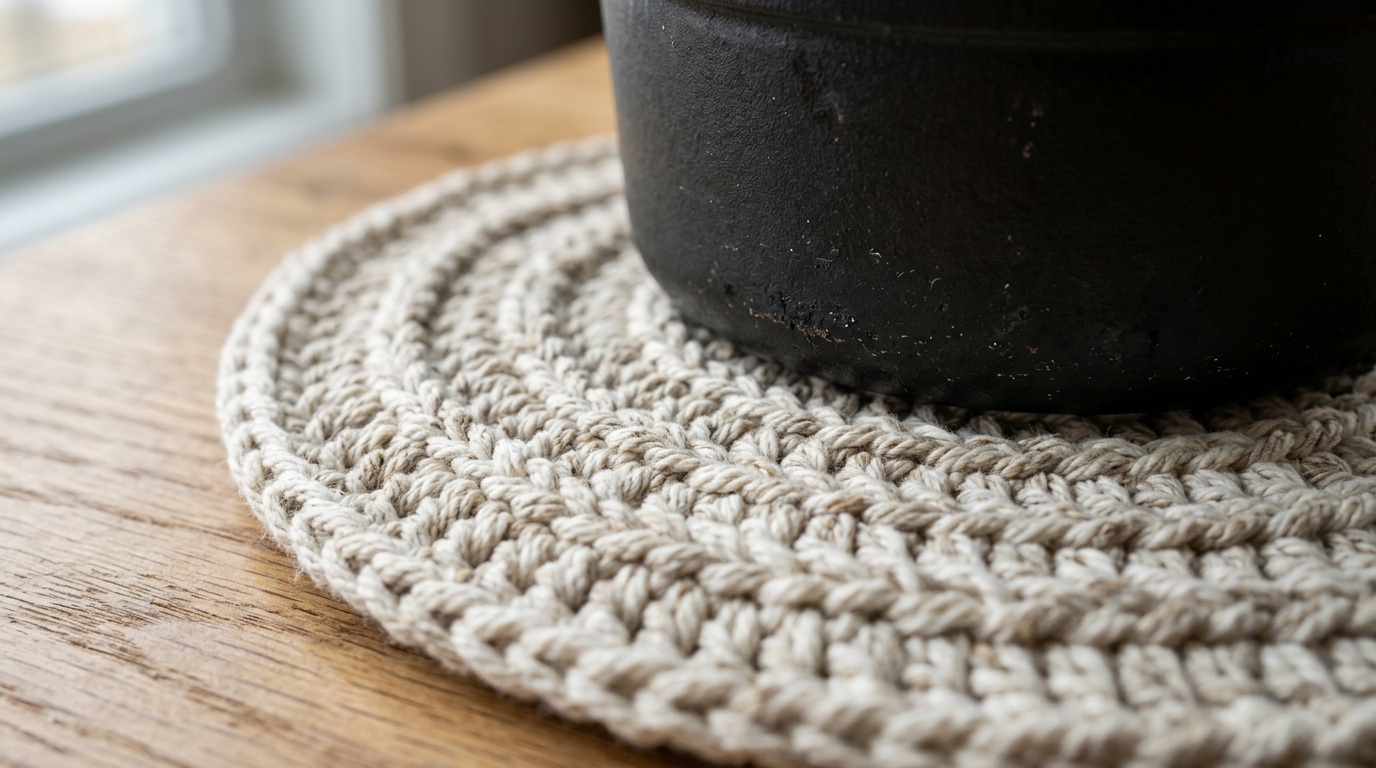
The secret to true thermal protection in fiber crafts is density. By holding two strands of 100% unmercerized worsted cotton together and working in continuous spiral rounds, you create a solid 1/2-inch thick barrier with zero open gaps. Finished with a textured crab stitch border and an integrated hanging loop, this modern trivet works up in under 45 minutes.
📋 Maker’s Project Blueprint & Specs
| Skill Level: | Beginner / Advanced Beginner |
| Finished Dimensions: | 9 inches (23 cm) round diameter |
| Yarn Requirements: | ~110 yards (100 m) worsted weight (Medium 4) 100% unmercerized cotton (worked holding 2 strands together) |
| Hook Size: | US J/10 (6.0 mm) ergonomic crochet hook |
| Gauge: | 7 rounds in Half Double Crochet spiral = 9 inches (23 cm) across |
| Completion Time: | 40 to 45 minutes |
“Pattern tested & hooked by Julian Brooks in my home studio. To evaluate tabletop protection, I tested this finished double-stranded trivet under warm ceramic and enameled cookware on an untreated pine table. The double cotton density buffered heat transfer effectively, keeping the table surface underneath protected. Working in a seamless spiral avoids the noticeable step-up seam of joined rounds, while the reverse single crochet border keeps the circular edges flat under everyday heavy dish weight.” — Julian Brooks, Home Living & Hands-On DIY Editor
Why Double-Stranded Cotton Is Essential for Trivets
- Substantial Thermal Cushion: Single-strand crochet can allow heat to bleed through stitch gaps. Holding two strands together compacts the fiber structure, creating a thick barrier that protects delicate dining table finishes.
- Preferred Natural Fiber: 100% unmercerized cotton is preferred for kitchen hot pads because it does not soften or melt like synthetic fibers (such as acrylic or polyester) when placed beneath warm cookware. Always use dense, double-thick construction and test finished items carefully before placing very hot cookware on heat-sensitive surfaces.
- Dimensional Stability: Double-stranded cotton provides enough natural rigidity to hold its flat round shape without curling upward or sagging under heavy Dutch ovens.
- Cohesive Kitchen Styling: Natural cream cotton coordinates effortlessly with modern rustic kitchens, matching our double thick crochet potholder and textured cotton dishcloths.
Materials & Tools

- Cotton Yarn: ~110 yards of worsted weight (Medium 4) 100% unmercerized cotton. You will hold two strands together throughout the pattern, so pull from two separate 50g balls or from both the outside and inside of a center-pull cake. For yarn recommendations, check out our guide on the best cotton yarns for crochet home projects.
- Crochet Hook: US J/10 (6.0 mm). Sizing up to 6.0 mm accommodates both yarn strands comfortably without straining your hands.
- Stitch Marker: Essential for marking the first stitch of each spiral round, since continuous spirals do not use slip stitch joins.
- Tapestry Needle: Large blunt metal needle for weaving in thick double-stranded tails.
- Measuring Tape: To verify your circular diameter matches the 9-inch target. For dimension comparisons, review our crochet coaster and hot pad size guide.
Crochet Abbreviations (US Terms)
- MR: Magic Ring
- Ch: Chain
- SC: Single Crochet
- HDC: Half Double Crochet
- Sl St: Slip Stitch
- St(s): Stitch(es)
- Crab Stitch (Reverse SC): Single crochet worked backwards from left to right instead of right to left.
Step-by-Step Modern Farmhouse Trivet Pattern
Part 1: The Spiral Foundation
Note: Hold two strands of worsted cotton together as one yarn strand throughout the entire pattern.
Round 1: Make a Magic Ring. Work 1 SC, then 7 Half Double Crochets (HDC) into the ring. Do not join with a slip stitch. Place your stitch marker into the first SC to mark the start of your round. (8 sts total)
Round 2: Work 2 HDC into each stitch around. Move your stitch marker up to the first stitch of this round. (16 sts)
Round 3: *Work 1 HDC in the next stitch, work 2 HDC in the following stitch*. Repeat from * around to marker. (24 sts)
Part 2: Expanding the Flat Circle
Even circular increases are crucial to prevent the hot pad from ruffling or cupping. If your circles ever begin to bowl, review our studio guide on why crochet curls and 7 practical fixes.
Round 4: *Work 1 HDC in each of the next 2 stitches, work 2 HDC in the following stitch*. Repeat from * around. (32 sts)
Round 5: *Work 1 HDC in each of the next 3 stitches, work 2 HDC in the following stitch*. Repeat from * around. (40 sts)
Round 6: *Work 1 HDC in each of the next 4 stitches, work 2 HDC in the following stitch*. Repeat from * around. (48 sts)
Round 7: *Work 1 HDC in each of the next 5 stitches, work 2 HDC in the following stitch*. Repeat from * around. (56 sts)
Smoothing the Spiral Transition: To level the spiral height before working the border, work 1 SC in the next stitch, then 1 Sl St in the following stitch.
Part 3: The Crab Stitch Border & Hanging Loop
The Crab Stitch (Reverse Single Crochet) produces a corded, rope-like rim that adds structural reinforcement along the outer perimeter.

Border Round: Ch 1. Do not turn your work. Insert your hook into the stitch directly to the right (backwards from normal crochet), yarn over, draw up a loop, yarn over, and pull through both loops. Repeat this reverse single crochet into each stitch around the circle.
Integrated Hanging Loop: When you reach the start of the border, do not fasten off. Chain 10 loosely. Skip 1 chain, slip stitch into each remaining chain back toward the trivet body, and slip stitch firmly into the base of the chain. Fasten off leaving an 8-inch tail.
Thread your tapestry needle with the double tails, secure them firmly along the back stitches of the border rim, and trim closely.
Styling & Tabletop Heat Protection

A handmade cotton trivet blends practical utility with relaxed organic modern design:
- Family-Style Serving: Place two or three matching trivets down the center runner of your dining table to serve hot skillets and baking dishes family-style without scrambling for metal trivets.
- Tea Station Anchor: Use one on your kitchen counter or coffee table to catch boiling water drips beneath your favorite ceramic teapot.
- Hanging Kitchen Decor: When not in active service, hang the trivet from a brass kitchen peg by its corner loop to add cozy textile warmth to blank subway tile walls.
Care & Laundering Instructions
- Washing: Machine wash in warm water with mild laundry detergent. Cotton can handle standard wash cycles easily.
- Drying: Lay flat on a clean dry towel and pat into a smooth 9-inch circle with your hands. Let it air dry naturally. Avoid hanging while soaking wet to keep the circle symmetrical.
- Steam Refresh: If the trivet edges curl slightly after repeated kitchen use, press lightly with a steam iron on the cotton setting to reset the flat circular shape.
Frequently Asked Questions
Why should I hold two strands of yarn together?
Holding two worsted cotton strands together doubles the fabric thickness to 1/2-inch, creating a dense thermal cushion that prevents heat from transferring from hot cookware to sensitive wood or quartz surfaces.
Can I use jute or hemp twine instead of cotton?
Yes! 3-ply natural jute or hemp twine creates a gorgeous rustic farmhouse trivet. Jute has very high heat resistance, though it has less give on your hands while crocheting. Use an aluminum hook with a comfortable grip if working with twine.
How do I make a larger 12-inch trivet for big baking pans?
Simply continue the circular increase pattern: Round 8 would be *6 HDC, 2 HDC in next*, Round 9 would be *7 HDC, 2 HDC in next*, and Round 10 would be *8 HDC, 2 HDC in next*, then finish with the Crab stitch border.
How heat-resistant is cotton for kitchen trivets?
100% cotton is the gold standard for crochet trivets because natural cellulose fibers do not melt like synthetics. However, no fabric textile is completely burn-proof. Avoid placing cookware straight from intense high-heat broilers onto fabric trivets, and always use a dense, double-strand construction to minimize heat transfer to sensitive surfaces.
Save This Pattern on Pinterest
Ready to protect your dining table with handmade texture? Pin this modern farmhouse crochet trivet tutorial to your Pinterest DIY and home craft boards for your next weekend project!
Made this yesterday afternoon for my heavy ceramic teapot! Double stranding the cotton makes such a sturdy, thick pad that really protects my wood table from the heat. My circle turned out a tiny bit bumpy where I joined the rounds, but the teapot covers it right up haha. Simple, quick, and so useful. Thank you Julian!
That vintage green teapot looks so charming on it Barbara! The double stranding definitely gives it that substantial heat buffer you want for heavy ceramic and cast iron. Don’t worry about the join seam at all—that’s the beauty of handmade pieces. So happy it’s earning a permanent spot on your table!