
Stepping out of a hot morning shower onto a cold, slick bathroom floor is a jarring reminder of how much functional textiles shape daily comfort. While synthetic memory foam bath mats trap damp odors and thin store-bought cotton rugs slide around dangerously on wet tiles, a handcrafted textured cotton bath mat offers immediate, sponge-like absorbency with tactile underfoot grip. By combining raised treble crochet post nubs in the center panel with an architectural front-post ribbed border and braided loop corners, this tested workshop pattern delivers a substantial 18×24-inch floor mat that stays flat, dries thoroughly, and endures regular high-heat laundering.
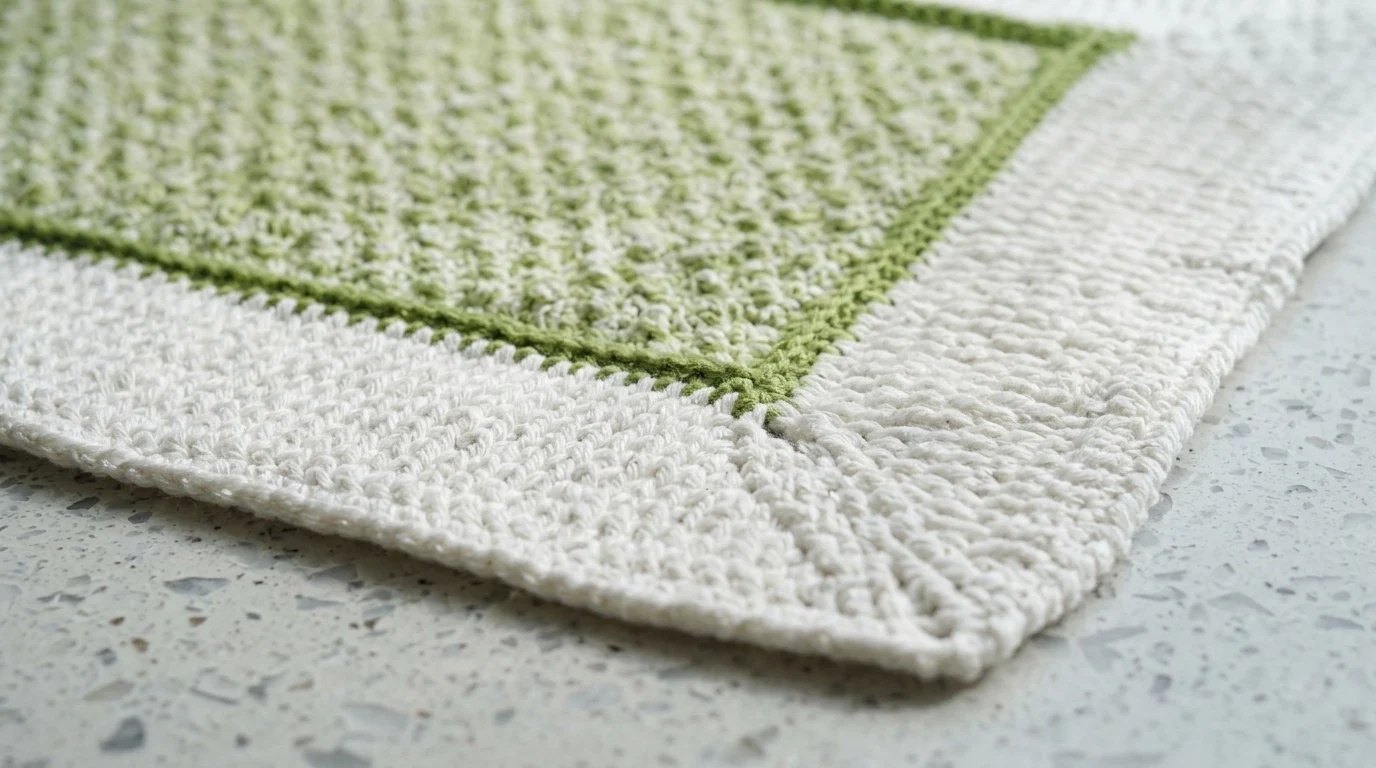
Crocheting floor textiles for damp, humid environments requires careful engineering. If the fabric is too thin, moisture penetrates straight through to the tile; if the stitch work is overly dense and compact, water cannot evaporate, risking mildew. The solution lies in a dual-texture construction: the center field uses staggered treble stitches pushed forward into three-dimensional ridges that act like miniature water reservoirs, while the surrounding ribbed border provides weighted perimeter stability that prevents the edges from curling upward when wet.
Project Blueprint: Dimensions, Gauge & Worsted Cotton Yardage
Before chaining your foundation row, reviewing the tested yarn yardage and gauge standards ensures your finished bath mat achieves balanced rectangular proportions without warping:
| Pattern Specification | Workshop Tested Standard | Practical Maker Notes |
|---|---|---|
| Finished Dimensions | 18 inches wide × 24 inches long (45.5 × 61 cm) | Standard bath mat proportion ideal for tub surrounds, single vanities, and shower stalls. |
| Skill Level | Easy / Confident Beginner | Uses single crochet, treble crochet post pushes, front-post double crochet, and reverse single crochet. |
| Yarn Requirement | Lily Sugar’n Cream 100% Worsted Cotton (Category 4) | Main Color (Sage Green): 6 balls; Contrast A (Deep Green): 2 balls; Contrast B (White): 6 balls. |
| Total Yardage | Approx. 1,020 yards (932 m) total across all three shades | 100% unmercerized cotton is mandatory for instant absorbency and heat tolerance. |
| Crochet Hook | Size U.S. J/10 (6.0 mm) ergonomic hook | A 6.0 mm hook allows relaxed cotton drape while creating tall, springy treble nubs. |
| Gauge | 10 single crochets × 11 rows = 4 inches (10 cm) | Checking gauge ensures the central nub panel matches the exact stitch ratio of the outer border. |
| Additional Tools | Steel yarn needle, 4 locking stitch markers, sharp fabric shears, measuring tape | Stitch markers clearly separate the four corner increase points during border rounds. |
Fiber Testing: Unmercerized Cotton vs Synthetic Chenille in Wet Zones
Selecting yarn for a bathroom rug involves safety, absorbency, and hygiene. In our studio washability trials testing synthetic fibers against natural plant fibers, 100% unmercerized cotton emerged as the clear winner across three everyday benchmarks:

- Instant Capillary Thirst: Unmercerized cotton has an open, natural fiber cuticle that wicks away standing water instantly. When stepping onto the mat with dripping wet feet, moisture is drawn deep into the yarn plies rather than sitting atop the surface.
- Sanitary High-Heat Laundering: Bath mats collect dampness, skin cells, and soap residue. Unlike polyester or acrylic chenille that melts or pills at high temperatures, pure cotton can be washed in hot water (140°F / 60°C) to sanitize bacteria and tumble-dried on medium heat without fiber degradation.
- Substantial Grounding Weight: The three-color worsted cotton construction provides natural structural heft. Weighing over a pound when completed, the mat settles flat against tile surfaces without bunching underfoot.
Stitch Mechanics: The Raised Treble Nubby Texture & Slip Resistance
The centerpiece of this bath mat features an ingenious stitch mechanism that creates dense, nubby texture without requiring complicated bobble clusters:

- The Post-Push Treble: By working a treble crochet (yarn over twice) between two short single crochets, the extra length of the treble has nowhere to go vertically. When pushed forward toward the right side, the stitch bows outward into a resilient, rounded loop that cushions bare feet.
- Staggered Texture Placement: Alternating the placement of the treble stitches on every other wrong-side row prevents vertical ridges from forming. Instead, it creates an offset honeycomb pattern of nubby nodes that provides gentle arch massage and superior non-skid traction.
- Flat Wrong-Side Backing: Because all posts are pushed toward the front of the work, the underside of the central panel remains smooth and flat, maximizing direct surface contact with your bathroom flooring.
Step-by-Step Construction: Working the Center Panel (Rows 1–5)
The bath mat begins with the textured center rectangle worked in your Main Color (Sage Green). Follow these exact workshop instructions to establish the 41-stitch active width:
Foundation Chain: Using your 6.0 mm hook and Main Color (MC), chain 42 loosely.
Row 1 (WS): Work 1 single crochet (sc) in the 2nd chain from your hook. Work 1 sc in each chain across to the end of the foundation chain. Turn. (41 sc total).
Row 2 (RS – Establishing First Nubs): Chain 1. Work 1 sc in the first sc. *Work 1 treble crochet (tr) in the next sc. Work 1 sc in the next sc (gently push the long vertical post of the previous treble forward toward the front of work).* Repeat from * across to the end of the row. Turn.
Row 3 (WS – Anchoring Row): Chain 1. Work 1 sc in each stitch across to the end of the row. Turn. (41 sc).
Row 4 (RS – Staggered Nubs): Chain 1. Work 1 sc in each of the first 2 sc. *Work 1 tr in the next sc, then work 1 sc in the next sc (push post forward).* Repeat from * across to the last sc. Work 1 sc in the last sc. Turn.
Row 5 (WS): Repeat Row 3 exactly. Turn.
Pattern Repeat: Repeat Rows 2 through 5 in sequence until the center panel measures exactly 12 inches (30.5 cm) from the foundation edge, ending on a completion of Row 3 or Row 5. Fasten off MC.
The Architectural Border: Ribbed Edging, Braided Corners & Crab Stitch
Once the center rectangle is complete, the outer border expands the mat by 6 inches, framing the textured sage center with crisp white post ridges and interlocking braided loops:

- Round 1 (Joining Contrast A): Join Contrast A with a slip stitch to the top right corner. Chain 2 (does not count as a stitch). Work 1 sc in each of next 40 sc, 3 sc in the corner. Work 28 sc evenly down the left edge, 3 sc in corner, 1 sc in each of 39 unworked foundation loops, 3 sc in corner, 28 sc up the right edge, and 2 sc in the starting corner. Join with a slip stitch to first sc. Turn.
- Rounds 2–3 (Back Loop Transition): Work single crochets around in the back loops only (blo), working 3 sc into each corner stitch to create crisp dimensional turning ledges. On Round 3, join Contrast B (White). Do not turn.
- Round 4 (Corner Chain Loops): With White, chain 3. Working in both loops, work 1 half double crochet (hdc) in each stitch across to the corner. In each corner stitch, work (1 hdc, chain 8, 1 hdc). Join with slip stitch.
- Round 5 and Ribbing Repeats: Work front-post double crochet (dcfp) across each side to build thick corded ribbing. In each corner, work (1 dcfp, 1 hdc, chain 8, 1 hdc, 1 dcfp). Repeat this round until the border measures 4 inches (10 cm) wide, adding 2 stitches at each corner on every round.
- The Braided Loop Interlock: Take the chain-8 corner loops from successive rounds and pull them through one another from bottom to top (pulling Round 6 loop through Round 5, Round 7 through Round 6, etc.). This creates a thick, decorative cable braid running up each of the four corners!
- Final Crab Stitch Perimeter: Cap the outer border with a round of reverse single crochet (working from left to right). This creates a corded, rope-like edge that locks all stitches against floor friction and prevents outer stretching.
Custom Sizing Matrix: Scaling from Small Powder Mat to Large Runner
The central nub pattern works over an odd number of stitches (foundation chain multiple of 2 plus 2). Use this tested chart to customize the bath mat for powder rooms or master suite vanities:
| Mat Classification | Starting Chain | Center Dimensions | Total Finished Size | Estimated Total Yardage |
|---|---|---|---|---|
| Powder Room Vanity Mat | Chain 32 | 9 × 10 in (23 × 25 cm) | 15 × 16 in (38 × 41 cm) | Approx. 650 yds (6 balls) |
| Standard Bath Mat (Tested) | Chain 42 | 12 × 18 in (30.5 × 45.5 cm) | 18 × 24 in (45.5 × 61 cm) | Approx. 1,020 yds (14 balls) |
| Large Master Spa Mat | Chain 52 | 16 × 24 in (40.5 × 61 cm) | 22 × 30 in (56 × 76 cm) | Approx. 1,450 yds (18 balls) |
| Double-Vanity Runner | Chain 42 | 12 × 42 in (30.5 × 107 cm) | 18 × 48 in (45.5 × 122 cm) | Approx. 1,800 yds (22 balls) |
Julian’s Safety & Care Notes: Non-Skid Backing & Machine Washing
Bathroom textiles must be safe to walk on and simple to keep fresh. Keep these practical maker notes in mind after completing your stitching:
- Adding Invisible Non-Skid Backing: While the heavy cotton weight provides natural stability on textured tile, smooth polished marble can be slippery. To ensure zero sliding, turn the finished mat over and apply thin wavy lines of clear silicone caulk or fabric latex paint across the back loop ridges. Allow to cure for 24 hours. The rubberized lines provide permanent, machine-washable floor grip.
- Laundering Without Fabric Softener: Machine wash warm on regular cycle with like colors. Avoid commercial liquid fabric softeners, which coat the natural cotton fibers in hydrophobic chemical films that destroy absorbency. Instead, add 1/2 cup of white vinegar to the rinse cycle to naturally soften the fibers and eliminate mineral stiffness.
- Reshaping the Ribbed Corners: When taking the mat out of the washing machine, give the four braided corners a firm tug outward before laying flat on a drying rack or tumble drying on low. This keeps the cable braids sharp and straight.
Bathroom Styling Coordinates & Complementary Maker Projects
A serene, spa-like bathroom relies on coordinated natural materials and consistent texture. Combine this bath mat with other tested workshop projects across our home library:
- Drying Linens & Hand Towels: Complement your floor mat at the sink with our absorbent Textured Cotton Kitchen & Bath Towel, featuring matching raised relief stitches and unmercerized cotton durability.
- Towel Hanging Solutions: Hang your drying linens cleanly beside the vanity using our tested Ring Towel Holder, which pairs natural cotton cord with smooth beechwood rings.
- Bedroom & Living Room Transitions: Carry cozy handmade textures beyond the bathroom door by layering our Modern Moss Stitch Blanket over low seating or stepping onto our chunky Modern Oval Floor Rug.
- The Gathering Bridge: If you are refreshing your guest bathroom before hosting weekend visitors, explore Claire Montgomery’s styling secrets in Moody Candlelit Fall Dinner Table Setting for warm lighting and natural botanical touches that make guests feel welcomed.
Frequently Asked Questions from Home Makers
How long does this cotton bath mat take to dry between showers?
Because unmercerized cotton breathes naturally and the treble nubs allow air to circulate between rows, the mat dries completely within 3 to 4 hours in a well-ventilated bathroom. For even faster drying, hang it over the edge of the tub or a towel rail after morning use.
Can I make this mat in a solid color instead of three shades?
Yes, absolutely. A monochrome version in natural cream or stone grey looks stunning in minimalist bathrooms. You will need approximately 9 to 10 solid 2.5 oz balls of Lily Sugar’n Cream cotton yarn.
Why are my treble nubs showing on the back of the mat?
When working Row 2 and Row 4, ensure you push the long post of the treble crochet forward toward the front of your work (facing away from you as you stitch). If left alone, treble posts naturally bulge toward the back; gently pushing them forward locks them onto the right side.
What is reverse single crochet (crab stitch)?
Reverse single crochet is worked exactly like standard single crochet, but stitched from left to right instead of right to left. Inserting your hook into the stitch to the right and drawing up a loop twists the yarn, creating a sturdy rope-like cord along the perimeter.
Will the colors bleed during the first machine wash?
Lily Sugar’n Cream worsted cotton is colorfast, but deep contrasting tones (like forest green against white) should be washed with 1 tablespoon of salt or 1 cup of white vinegar during their initial cycle to set the dye molecules permanently.
Save This Textured Bath Mat Pattern to Pinterest
Looking to elevate your bathroom with durable, handmade spa luxury? Save this tested textured cotton crochet bath mat pattern to your Pinterest home decor and fiber arts boards so you have the stitch mechanics, yardage chart, and non-skid backing guide ready for your next weekend project!
Leave a Comment