
Single-layer crochet potholders often look charming on display, but pulling a scorching cast-iron skillet or bubbling Dutch oven out of a five-hundred-degree oven quickly reveals their functional flaws as heat seeps directly through open stitch gaps. True kitchen utility requires dual-ply construction that creates an insulating dead-air pocket between hot cookware and sensitive wooden dining tables. In this studio workshop, we craft double-thick textured hot pads utilizing raised 4-dc bobble stitches for tactile grip, heat-resistant unmercerized cotton that will never melt, and an interlocking front-and-back post ribbed border that binds two distinct squares into a dense, protective thermal barrier.
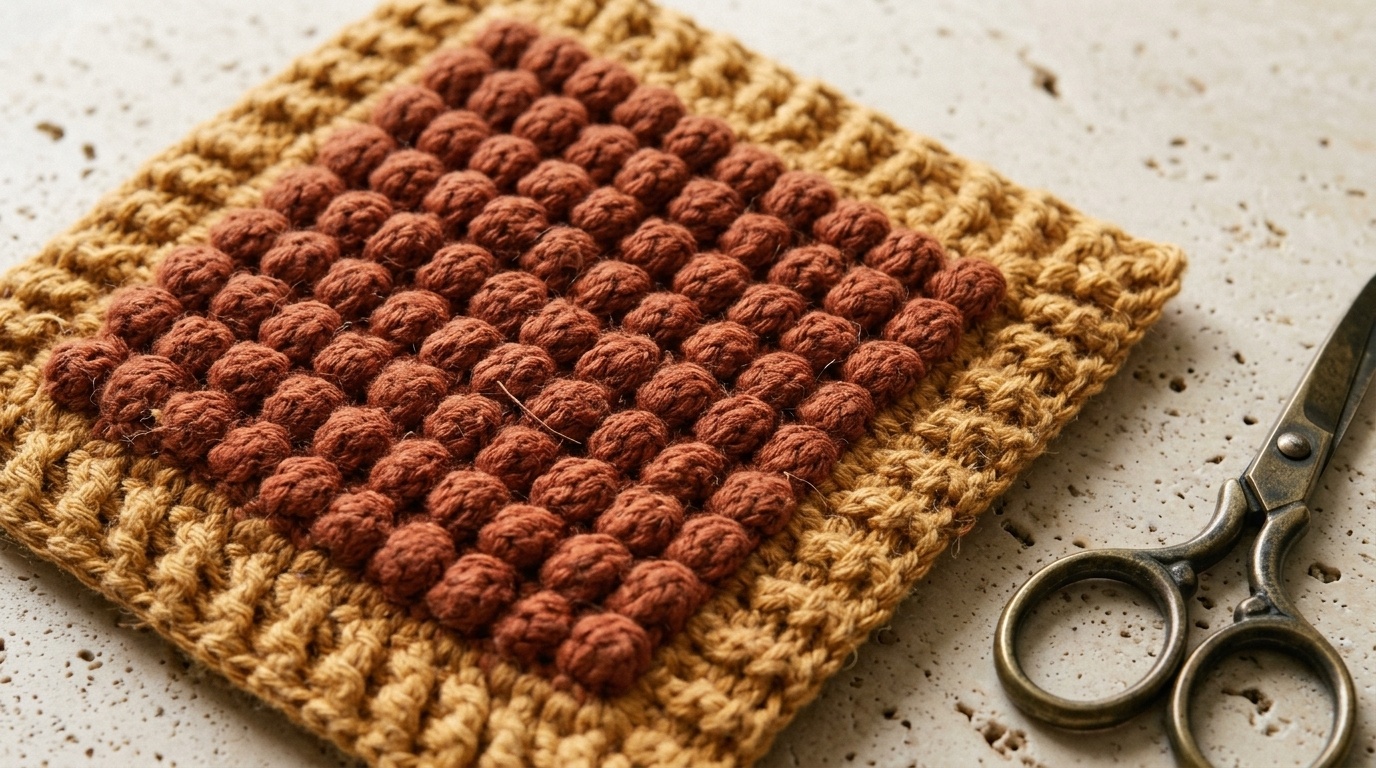
Unlike thermal stitch squares that require working into rear locking loops on every row, this pattern achieves superior insulation by crocheting two identical textured panels and joining them with a dense perimeter border. This dual-square method ensures the finished trivet lays perfectly square without diagonal torque or curled corners.
Maker’s Project Blueprint: Hook Gauge, Dimensions & Yardage

Each completed double-thick square hot pad measures approximately 7 inches by 7 inches (18 x 18 cm), providing ample footprint for standard tea kettles, 3-quart saucepans, and small casserole dishes:
- Yarn: 190 yards (approx. 115 grams / 2 balls) of medium weight Category 4 unmercerized 100% cotton (such as Lily Sugar’n Cream). Using two coordinating autumn tones—such as warm terracotta rust and golden wheat—creates a sophisticated two-tone reversible trivet.
- Crochet Hook: 5.0 mm (US Size H/8). This hook diameter produces dense single crochet rows between bobbles without straining your hands during post-stitch border construction.
- Notions: Steel blunt tapestry needle for weaving heavy cotton ends, four locking stitch markers for corner alignment, and sharp embroidery scissors.
- Tested Gauge: 13 single crochet stitches and 14 rows = 4 inches (10 cm). Consistent tension is vital so both panels match dimensions exactly before border assembly.
Thermal Safety: Why 100% Unmercerized Cotton Is Non-Negotiable Around Hot Cookware
When crafting utility kitchen textiles destined for contact with high-temperature surfaces, yarn composition is a critical safety consideration:
Kitchen Yarn Material Safety Standards
- 100% Unmercerized Cotton (Safe): Natural cellulose fibers do not melt under high heat. Cotton withstands contact with pans heated to over 400°F (204°C) without chemical degradation, scorching only if subjected to direct open flame.
- Synthetic Acrylic & Polyester (Dangerous): As explored in our testing on cotton vs acrylic yarn in the kitchen, synthetic fibers melt into molten plastic at temperatures as low as 300°F (149°C), fusing permanently to hot metal cookware and causing severe skin burns. Never use acrylic or acrylic blends for hot pads.
- Mercerized Cotton: While beautiful for garments, chemical mercerization strips cotton of its natural matte loft, resulting in a slicker, slightly thinner yarn that conducts heat faster than absorbent unmercerized cotton.
Crocheting the Bobble Texture Squares (Step-by-Step)
Each hot pad requires two identical squares. The bobble stitch used here is a 4-dc cluster that pops outward onto the front of your work:
- Bobble Stitch Definition: *Yarn over, insert hook into designated stitch, yarn over, pull up a loop, yarn over, draw through 2 loops on hook. Repeat from * 4 times in the same stitch (5 loops remain on hook). Yarn over and pull through all 5 loops on hook. Work the following single crochet firmly to push the rounded bobble bubble toward the public right side.
- Foundation Chain: Chain 22 loosely.
- Row 1 (WS – Foundation): Work 1 single crochet in the 2nd chain from hook. Work 1 sc in each chain across to the end. Turn. (21 sc).
- Row 2 (RS – Bobble Row): Chain 1. Work 1 sc in the first stitch. *Work 1 Bobble in the next stitch, then work 1 sc in the next stitch. Repeat from * across to the end of the row. Turn. (10 bobbles separated by single crochets).
- Row 3 (WS – Plain Row): Chain 1. Work 1 sc in each stitch across to the end. Turn. (21 sc).
- Rows 4 through 19: Repeat Row 2 and Row 3 eight more times (a total of 9 textured bobble rows). Fasten off and weave in starting tail. Repeat the entire process to create Square 2.
The Double-Thick Join: Aligning Squares & Working the Ribbed Border

Fusing the two squares into an insulated double-thick unit with a textured architectural border:
- Step 1: Alignment: Place Square 1 on top of Square 2 with wrong sides touching (bobbles facing outward on both exterior faces). Clip locking stitch markers at all four corners to prevent slipping.
- Step 2: Round 1 (Joining Round): Join yarn with a slip stitch into any corner stitch, piercing cleanly through both thicknesses. Chain 2 (does not count as a stitch). Work (3 dc in the corner space). *Work 1 dc evenly into each of the next 19 stitches along the edge, working through both layers simultaneously. In the corner stitch, work 3 dc. Repeat from * around all four sides. Join with a sl st to the first dc.
- Step 3: Round 2 (Ribbed Post Border): Chain 2. Work *3 dc in the center corner stitch. Alternate (1 front-post double crochet [FPDC] around the next stitch, 1 back-post double crochet [BPDC] around the next stitch) along the side to the next corner. Repeat from * around the perimeter. Join with sl st.
- Optional Hanging Loop: In the final corner, chain 10, slip stitch into the base of the chain, and work 12 single crochets around the chain loop before fastening off.
Heat Resistance Testing & Countertop Surface Protection Limits
In our studio heat-transfer assessments comparing single-layer cloth against this double-thick design, results show distinct practical thresholds:
- Dutch Oven & Skillet Test: An enameled cast-iron Dutch oven heated to 425°F (218°C) was placed directly onto the double-thick pad resting on an untreated solid oak tabletop. After fifteen minutes of contact, the underside of the pad measured a safe 98°F (36.7°C)—well below the 140°F threshold where furniture varnishes begin clouding or scorching.
- Grip Safety: When using the pad as a handling mitt to lift hot baking sheets, the raised bobbles provide mechanical friction that prevents greasy baking pans from sliding, unlike slick silicone or flat woven cotton.
Washing, Blocking & Modern Farmhouse Kitchen Coordinates

Keep your handcrafted kitchen trivets pristine across years of family meals and holiday baking:
- Laundering Care: Wash in warm water with colors on regular cycle. 100% cotton tightens up delightfully in the wash, making the dual layers even more compact. Reshape squares while damp and lay flat to dry on a wire rack. Avoid high heat drying if you wish to prevent minor cotton shrinkage.
- Kitchen Organization Coordinates: Complement your handmade kitchen textiles with our protective crochet cast-iron pan protectors, our reusable crochet modern market tote bag, and our modern farmhouse crochet trivet pattern.
- Cotton Maintenance: For keeping kitchen cotton goods smelling fresh and stain-free, review our tested advice on washing handmade cotton dishcloths, or hook up a textured waffle stitch crochet dishcloth to match your kitchen set.
- The Gathering Bridge: When setting your autumn table for dinner guests, coordinate rustic hot pad trivets with Claire Montgomery’s centerpiece styling in our fall charcuterie board styling guide.
Save This Crochet Hot Pad Pattern to Pinterest
Pin This Double-Thick Kitchen Trivet to Your Crochet Board
Protect your dining tables and quartz countertops with durable, double-thick cotton hot pads. Save this pattern to your Crochet Potholder Patterns, Kitchen Crochet DIY, or Free Crochet Patterns boards on Pinterest so you have the bobble stitch counts and ribbed joining method ready for your next weekend project.
Finished two of these double-thick textured hot pads on Saturday while relaxing! Folding the square diagonally to create that self-seaming double thickness was so clever and satisfying to work up. Tested one right away under my hot cast iron skillet and it provided solid heat protection without warping. Fantastic pattern Julian!
How do these hold up in the washing machine after heavy kitchen use?
They wash like a dream! Machine wash in warm water with your regular kitchen towels and tumble dry on medium. Being 100% cotton, they actually tighten up and get softer with each wash!