
Heavy cast iron skillets and enameled Dutch ovens are the undisputed workhorses of a well-equipped home kitchen, but storing them efficiently is a notorious challenge. In compact kitchen cabinets, nesting pans inside one another is often the only realistic way to conserve vertical shelf space. However, metal-on-metal friction during everyday stacking quickly leads to micro-chipped enamel, gouged cooking surfaces, and scraped-off seasoning rings. These handmade 100% cotton starburst pan protectors provide thick, washable mechanical cushioning that folds upward along the pan’s curved sidewalls, preserving your cookware investments for a lifetime.
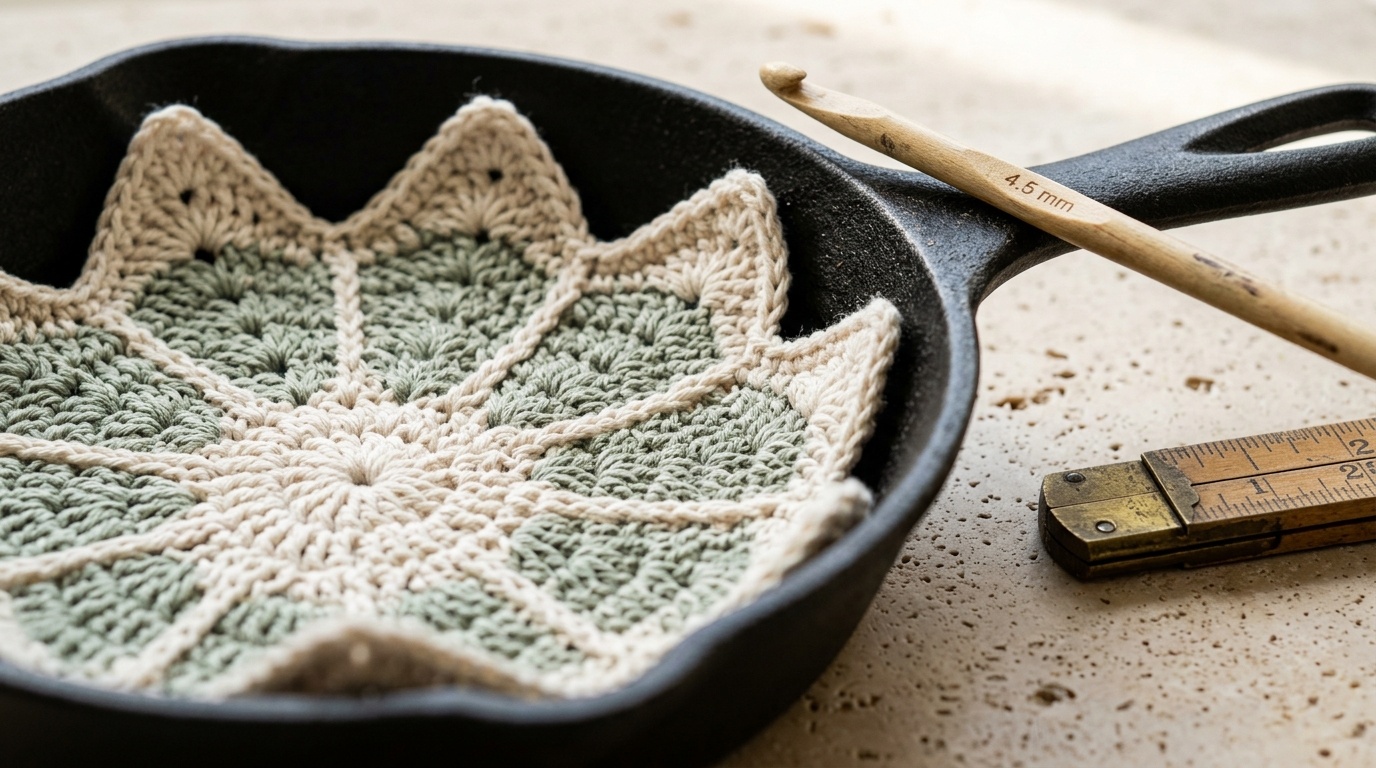
While commercial felt dividers are widely sold online, synthetic felt absorbs residual seasoning oils, holds onto moisture, and cannot be laundered repeatedly without pilling into a fuzzy mess. By crocheting your own cookware dividers from dense, unmercerized worsted cotton, you create breathable, washable barriers custom-sized to your exact 8-inch, 10-inch, and 12-inch skillet collections.
KITCHEN TRIVET UPGRADE: Protect your wood surfaces from sizzling Dutch ovens with our tested pattern on how to crochet double-thick textured hot pads using heat-resistant cotton bobbles.
Why Stacking Heavy Cookware Ruins Enameled & Seasoned Iron
Cast iron is renowned for its durability under high heat, but its seasoned patina and ceramic vitreous enamel coatings are physically vulnerable to point-load impact. When you drop a 6-pound, 10-inch skillet directly into a 12-inch pan, the rough machined bottom of the upper pan grinds against the polished cooking surface below.
For enameled cookware (such as Le Creuset or Staub Dutch ovens), this friction causes microscopic enamel stress fractures that eventually flake off during high-heat cooking. For bare seasoned cast iron, rim contact rubs away the polymerized oil layer, exposing raw iron to ambient cabinet humidity and inviting surface rust. A 5mm-thick cotton buffer eliminates metal-on-metal contact entirely.
The 6-Point Starburst Architecture: Cushioning the Rim and Base
Flat circular discs—like oversized mug rugs—work well on table tops, but fail inside nested cookware. As soon as you place a pan inside a skillet lined with a flat circle, the flat disc bunches awkwardly in the corners while leaving the upper rim completely exposed to rim-to-rim collisions.
Our tested 6-point starburst design solves this geometry. A solid circular center pad (ranging from 6 to 9 inches across) protects the flat skillet base, while six tapering petals fan outward. When the upper pan is lowered into place, these six petals automatically fold upward along the sidewalls, creating a protective cradle that extends all the way to the top pouring lips.
Maker’s Sizing Blueprint: Small, Medium & Large Pans
- Small Protector (Fits 6″ to 8″ Skillets): 12 inches total tip-to-tip span (5.5″ base disc + 3.25″ petal length). Consumes ~70 yards of worsted cotton.
- Medium Protector (Fits 10″ Skillets & 3.5-Qt Dutch Ovens): 15 inches total tip-to-tip span (7.5″ base disc + 3.75″ petal length). Consumes ~105 yards of worsted cotton.
- Large Protector (Fits 12″ Skillets & 6-Qt Braisers): 18 inches total tip-to-tip span (9.5″ base disc + 4.25″ petal length). Consumes ~140 yards of worsted cotton.
- Recommended Hook: 4.5 mm (US 7) blonde birch crochet hook for dense, snag-free stitchwork.
- Storage Safety Standard: Designed strictly for cabinet storage and cupboard nesting. Not intended for use as high-heat oven mitts or stove-top trivets.
Yarn Fiber Safety: Why 100% Unmercerized Cotton Wins in Cabinets

Choosing the correct yarn for kitchen storage accessories is essential for cookware preservation and food hygiene:
- 100% Unmercerized Cotton: Multi-ply unmercerized cotton (such as Oak & Thread or Lily Sugar’n Cream) features a matte, non-slip texture that grips heavy cast iron without sliding around during cabinet movement.
- Avoid Synthetic Acrylic & Polyester: Synthetic yarns do not breathe. If a freshly washed pan has even a microscopic drop of residual moisture under the handle, synthetic fibers can trap moisture against the iron, causing oxidation and rust spots.
- Pure Cotton Washability: Cookware seasoned with grapeseed oil or beef tallow will transfer faint traces of natural fat to the protector over time. Cotton fibers withstand regular hot-water laundering and degreasing with dish soap without degrading.
Step-by-Step Starburst Construction: Center Disc to Extended Petals
Stage 1: The Dense Center Base Disc
Begin with a magic ring using Color A (natural cream) on a 4.5 mm hook. Work 6 single crochet into the ring and pull tight. Work in continuous spiral rounds (marking your first stitch with a locking bulb marker): work 2 sc in each stitch around (12 sc), then alternate [1 sc, 2 sc in next] around (18 sc). Continue standard circle increases until your base reaches the required diameter (e.g., 7.5 inches for a 10-inch skillet). Sl st into the next stitch to finish the flat circle.

Stage 2: Establishing & Shaping the 6 Petals
Count your total outer rim stitches and divide by 6 (e.g., 54 stitches ÷ 6 = 9 stitches per petal). Join Color A at your first stitch:
- Row 1: Chain 2 (counts as hdc), hdc in next 8 stitches. Turn (9 stitches).
- Row 2: Chain 2, hdc2tog (decrease), hdc across to last 3 stitches, hdc2tog, hdc in last stitch. Turn (7 stitches).
- Row 3: Repeat decrease row to taper the sides smoothly (5 stitches).
- Row 4: Repeat decrease row (3 stitches).
- Row 5: Chain 2, hdc3tog across the remaining 3 stitches. Fasten off.
- Repeat this sequence around the remaining five segments to form a symmetrical 6-point starburst.
Stage 3: Contrast Border & Edge Reinforcement
Using Color B (muted sage green), join at any petal valley with a slip stitch. Single crochet evenly along the edges of all 6 petals, placing 3 sc in the tip of each petal to keep the points flat. This unified perimeter border prevents the petal sides from curling and provides clean visual contrast.
Cabinet Nesting Harmony: Organizing Heavy Dutch Ovens & Skillets

Once your protectors are finished, organizing heavy cookware becomes effortless and quiet:
- Vertical Skillet Towers: Stack your 12-inch, 10-inch, and 8-inch skillets in descending order with a protector between each layer. You can retrieve individual pans without noisy metal clanging or scuff marks.
- Enameled Dutch Oven Lids: Place a medium protector inside your Dutch oven, invert the heavy lid upside down into the pot, and fold the petal tips over the lid handle. This allows you to stack a second Dutch oven or braiser directly on top without scratching the enamel knob.
- Coordinating Table Accents: To coordinate your kitchen storage with your tabletop dining textiles, pair these dividers with our modern crochet farmhouse trivet pattern.
- Yarn Selection Reference: If testing alternative cotton brands from your stash, check our laboratory review of the best cotton yarns for durable kitchen crochet.
- The Gathering Bridge: When preparing one-skillet meals for autumn dinner parties, pair clean cookware storage with Claire Montgomery’s hosting guide for a casual weeknight one-skillet dinner party.
Laundering & Hygiene: Keeping Storage Protectors Oil-Free
Because these protectors sit directly against seasoned cast iron, they will gradually absorb trace seasoning fats over months of storage. Maintain them with ease:
- Degreasing Soak: If protectors feel slightly oily after a season of use, soak in warm water with two drops of grease-cutting liquid dish soap for 20 minutes before machine washing.
- Machine Wash Gentle: Wash in cold or warm water on a gentle cycle inside a mesh laundry bag.
- Air Dry Flat: Lay flat on a clean towel to dry. Because cotton retains its shape when damp, smooth the petals outward with your fingers to ensure they sit flush inside your cookware.
Save This Pan Protector Pattern to Your Kitchen Organization Board
Ready to protect your enameled Dutch ovens and heirloom cast iron skillets? Save this free starburst pan protector pattern to your Kitchen Organization or Crochet Home Crafts board on Pinterest so you have the sizing blueprint ready whenever you add to your cookware collection!
Attempted this as my first ever home decor crochet project! My tension was a little tight at the beginning, but your photos made following along so straightforward. Already picking yarn colors for a full set!
My foundation chain feels a bit stiffer than the subsequent rows. Should I go up a full hook size just for the starting chain?
Spot on! Going up a half or full millimeter on just the foundation chain is a veteran maker trick. It gives the base stitches room to breathe so your bottom edge never pulls tight. Give that a try!